
SEO Trends 2026: What’s Actually Working Now
If your SEO strategy still looks the same as it did two years ago, it is almost certainly underperforming. The search the SEO landscape in 2026 in 2026 bears little resemblance to the one we navigated in 2024, and the businesses that have adapted are already reaping the rewards.
This is not a speculative piece about what might happen. This is a field report from the front lines of search engine optimisation — grounded in what we are seeing work right now, across dozens of client campaigns, here at Agile Digital Agency.
From AI Overviews reshaping the search results page to the growing importance of brand citations and entity SEO, the rules have changed. And whether you are a law firm, a financial services provider, a SaaS company, or a consultancy, understanding these shifts is no longer optional.
Let us walk you through what is actually working in 2026 — and, more importantly, what you should do about it.
Key Takeaways
- AI Overviews now dominate the top of Google search results, making zero-click searches the norm rather than the exception. Your content must be structured to be cited, not just ranked.
- Generative Engine Optimisation (GEO) is a distinct discipline — optimising for AI-generated answers requires different tactics than traditional SEO, though both work together.
- Entity SEO has moved from niche concept to core strategy. Google and AI systems need to understand who you are, not just what your pages say.
- E-E-A-T signals carry more weight than ever, particularly for YMYL (Your Money or Your Life) sectors. First-hand experience and demonstrable expertise are essential.
- Brand citations are becoming as valuable as backlinks. Unlinked mentions across authoritative sources help AI systems validate your credibility.
- Structured data is the language AI actually understands. Schema markup is no longer a technical nice-to-have — it is fundamental infrastructure.
- AI-generated content is not penalised per se, but low-quality, unreviewed AI output absolutely is. Human oversight and editorial standards remain non-negotiable.
- Technical SEO still underpins everything. If search engines cannot crawl, render, and index your content properly, nothing else matters.
The SEO Landscape Has Fundamentally Shifted
For years, SEO was largely about a predictable formula: research keywords, create content around them, build backlinks, and wait for the rankings to climb. That formula still has its place, but in 2026 it is no longer sufficient on its own.
The search engine results page (SERP) itself has changed beyond recognition. Google’s AI Overviews now appear at the top of a significant proportion of queries, delivering synthesised answers that often satisfy user intent without a single click to an external website. Meanwhile, AI-powered search engines such as Perplexity, and the AI features built into Bing via Copilot, are training users to expect conversational, cited responses rather than lists of blue links.
This has created a fundamental tension: organic traffic from traditional rankings is declining for many query types, yet the businesses that appear as cited sources in AI-generated answers are building extraordinary authority and trust.
The question is no longer simply “How do I rank number one?” It is “How do I become the source that AI trusts and references?”
If you want a broader perspective on this shift, our guide on the evolution of traditional SEO in 2026 provides essential context.
AI Overviews and the Rise of Zero-Click Search
Google’s AI Overviews (formerly known as Search Generative Experience, or SGE) are now a permanent fixture across most English-language search markets. When a user types a question, Google frequently generates a multi-paragraph answer at the very top of the page, drawing from multiple sources and synthesising information in real time.
The implications for businesses are profound.
For informational queries, many users no longer scroll past the AI Overview. They read the synthesised answer, note the cited sources, and move on. This is the zero-click search phenomenon taken to its logical extreme — and it means that even if your content informed the answer, you may not receive a direct visit.
However, there is a crucial silver lining. The sources that are cited within AI Overviews gain significant brand visibility and implied endorsement from Google. Being referenced in an AI Overview positions your brand as an authority, which has downstream effects on brand recall, direct searches, and conversion rates.
We have written extensively about how AI Overviews are transforming search strategy, including the data on click-through patterns and citation behaviour. It is well worth reading if you have not already.
What Zero-Click Means for Your Strategy
The rise of zero-click search does not mean SEO is dead. Far from it. But it does mean your approach must evolve. Here is what we recommend:
- Optimise for citation, not just clicks. Structure your content so that key statements, statistics, and definitions are easily extractable by AI systems. Use clear, concise paragraph openings that directly answer likely questions.
- Pursue queries with commercial and transactional intent. Informational queries are most affected by zero-click. Queries where users need to take action — enquire, compare, purchase — still drive substantial click-through.
- Build brand recognition within AI answers. Even if users do not click, seeing your brand name cited repeatedly builds trust and familiarity. This is the new form of above-the-fold visibility.
- Track AI Overview presence as a KPI. Traditional rank tracking is no longer enough. You need to monitor whether your content appears in AI-generated answers, and how frequently your brand is cited.
For a deeper dive into tactical responses to zero-click trends, see our guide on zero-click search strategies for professional services.
Generative Engine Optimisation (GEO): The New Frontier
If SEO is the practice of optimising for search engines, then GEO — Generative Engine Optimisation — is the practice of optimising for AI-powered answer engines. And in 2026, the distinction matters enormously.
GEO encompasses the strategies needed to ensure your brand and content are surfaced, cited, and recommended by generative AI systems. These include not only Google’s AI Overviews but also standalone AI tools such as ChatGPT (now with real-time web access), Perplexity, Gemini, and others that users increasingly turn to for research and recommendations.
The key difference between SEO and GEO lies in how these systems select sources. Traditional search ranks pages based on a combination of relevance, authority, and technical signals. Generative AI systems, by contrast, look for content that is factually clear, well-structured, unambiguous, and associated with a recognisable, trustworthy entity.
Our practical introduction to Generative Engine Optimisation (GEO) explains these differences in detail and is an essential starting point if this concept is new to you.
How to Optimise for GEO in Practice
Optimising for generative engines is not a matter of bolting on a few new tactics. It requires a shift in how you think about content creation. Here are the practical steps that are delivering results:
- Write definitive, citable statements. AI systems extract and quote specific passages. Ensure your content includes clear, authoritative sentences that can stand alone as cited facts. Avoid vague language and hedging where possible.
- Use structured formats consistently. Numbered lists, comparison tables, step-by-step guides, and clearly labelled sections make it easier for AI to parse and extract your content. This is not about dumbing down — it is about clarity.
- Provide original data and unique perspectives. AI systems are trained to value original research, proprietary data, expert commentary, and novel viewpoints. Regurgitating widely available information will not differentiate you.
- Maintain factual accuracy rigorously. Generative engines are increasingly sophisticated at cross-referencing claims. Content with factual errors or outdated information is less likely to be cited.
- Implement comprehensive schema markup. Structured data helps AI systems understand the context, authorship, and subject matter of your content. We will cover this in more detail shortly.
For those ready to go further, our advanced guide on mastering GEO tactics covers the more sophisticated strategies that separate good from excellent.
Entity SEO: Why Google Needs to Know Who You Are
Entity SEO is arguably the most under-discussed yet consequential shift in search optimisation over the past two years. And in 2026, it is no longer an advanced concept — it is a foundational requirement.
An entity, in Google’s understanding, is a clearly defined thing — a person, organisation, place, concept, or product — that can be identified unambiguously. Google’s Knowledge Graph contains billions of entities and the relationships between them, and this graph is central to how both traditional search and AI systems determine relevance and authority.
When Google recognises your business as an entity, remarkable things happen. Your brand name starts appearing in knowledge panels, AI Overviews, and related searches. Your content is associated with your organisation rather than treated as anonymous web pages. And AI systems can confidently cite you because they understand who you are and what you specialise in.
Without entity clarity, you are effectively invisible to the layer of search that matters most in 2026.
Building Your Entity Profile
Establishing yourself as a recognised entity requires deliberate, consistent action across multiple fronts:
- Consistent brand naming across all platforms. Your business name, key personnel names, and service descriptions should be identical across your website, Google Business Profile, social media, directory listings, and third-party mentions. Even minor inconsistencies can confuse entity recognition.
- Comprehensive Organisation schema on your website. This tells search engines precisely who you are, where you operate, what services you provide, and who your key people are. It is the digital equivalent of a formal introduction.
- Author profiles with Person schema. Every piece of content should be attributed to a named author with a dedicated profile page. That page should include biographical details, credentials, social links, and Person schema markup.
- Presence across authoritative third-party sources. Google cross-references your claims about yourself with what the rest of the web says about you. Being mentioned in industry publications, reputable directories, and professional bodies reinforces your entity status.
- A Wikipedia or Wikidata entry (where warranted). For larger organisations, a Wikipedia page remains one of the strongest entity signals. Even a Wikidata entry can help Google’s Knowledge Graph recognise your brand.
If you want to understand the strategic framework behind entity-based optimisation, our guide to AI-first SEO for professional services covers the full methodology.
E-E-A-T in 2026: Experience Is No Longer Optional
Google’s E-E-A-T framework — Experience, Expertise, Authoritativeness, and Trustworthiness — has been part of its Search Quality Rater Guidelines for several years now. But in 2026, the practical enforcement of these principles has intensified significantly, particularly for YMYL (Your Money or Your Life) content.
The addition of the first E — Experience — was a signal that Google increasingly values content created by people who have genuine, first-hand knowledge of their subject matter. This is not merely about credentials on paper. It is about demonstrable evidence that the author has actually done the thing they are writing about.
For professional services firms, this is both a challenge and an opportunity. A challenge because many firms still publish content under generic bylines or brand accounts. An opportunity because, if you can genuinely demonstrate the experience and expertise of your team, you have a significant competitive advantage.
How to Demonstrate E-E-A-T Effectively
- Attribute content to named, qualified authors. Every blog post, guide, and thought leadership piece should carry a real author name with a linked biography page that details their relevant qualifications and experience.
- Include case studies and real-world examples. Content that references actual projects, client outcomes (with appropriate permissions), or specific professional experiences signals first-hand knowledge that AI systems and human reviewers alike can recognise.
- Cite authoritative sources and original research. Link to academic studies, industry reports, and official documentation where relevant. This demonstrates rigour and positions your content within a trusted information ecosystem.
- Maintain transparency about your organisation. Clear “About” pages, team profiles, contact information, registered company details, and professional accreditations all contribute to trustworthiness signals.
- Keep content current. Outdated content actively harms E-E-A-T. Establish a regular content review cycle to ensure that facts, statistics, and recommendations remain accurate and relevant. This very article is a case in point — we replaced its 2024 predecessor because the SEO landscape moved on.
For a broader exploration of trust-building strategies that support E-E-A-T, our piece on building trust online for professional services is highly relevant.
Topical Authority and Content Clusters
If there is one SEO concept that has graduated from theory to absolute necessity in 2026, it is topical authority. Search engines — and the AI systems built on top of them — no longer evaluate individual pages in isolation. They assess whether a website demonstrates comprehensive expertise across a clearly defined subject area.
This is where content clusters become strategically vital.
A content cluster is a group of interlinked articles that collectively cover a topic in depth. At the centre sits a comprehensive pillar page that provides a broad overview of the subject. Surrounding it are supporting articles that explore specific subtopics, questions, and use cases in detail. All pieces link to each other in a logical, hierarchical structure.
From Google’s perspective, this structure signals that you do not merely touch upon a subject — you own it. And AI systems, which are designed to identify the most comprehensive and reliable sources, reward this depth heavily.
Building Effective Topic Clusters
Here is a practical framework for building topic clusters that perform:
- Identify your core topics. Choose three to five subject areas that align with your services and your clients’ needs. These become your pillar themes. For a law firm, this might be employment law, commercial disputes, and regulatory compliance. For a digital agency, it might be SEO, web design, and content strategy.
- Conduct thorough keyword research around each pillar. Map out every question, subtopic, and related search query associated with each core theme. This forms the blueprint for your supporting content.
- Create comprehensive pillar pages. Each pillar page should serve as the definitive resource on its topic — broad enough to cover the essentials, detailed enough to demonstrate genuine expertise, and well-structured enough to serve as a navigational hub.
- Develop supporting articles that go deep on specific subtopics. Each supporting article should target a specific question or aspect of the broader theme, providing the depth and detail that the pillar page cannot.
- Implement strategic internal linking. Every supporting article should link back to its pillar page and to related supporting content. The pillar page should link out to all supporting articles. This creates a clear semantic relationship that search engines and AI systems can follow.
At Agile Digital Agency, we build topic clusters into every content strategy we develop for clients. The results speak for themselves: sites with well-structured clusters consistently outperform those with scattered, disconnected content — in both traditional rankings and AI citation frequency.
Brand Citations: The New Backlinks
For the better part of two decades, backlinks have been the currency of SEO authority. And they still matter — let us be clear about that. A strong backlink profile remains a significant ranking factor.
But in 2026, a parallel authority signal has emerged that deserves equal attention: brand citations.
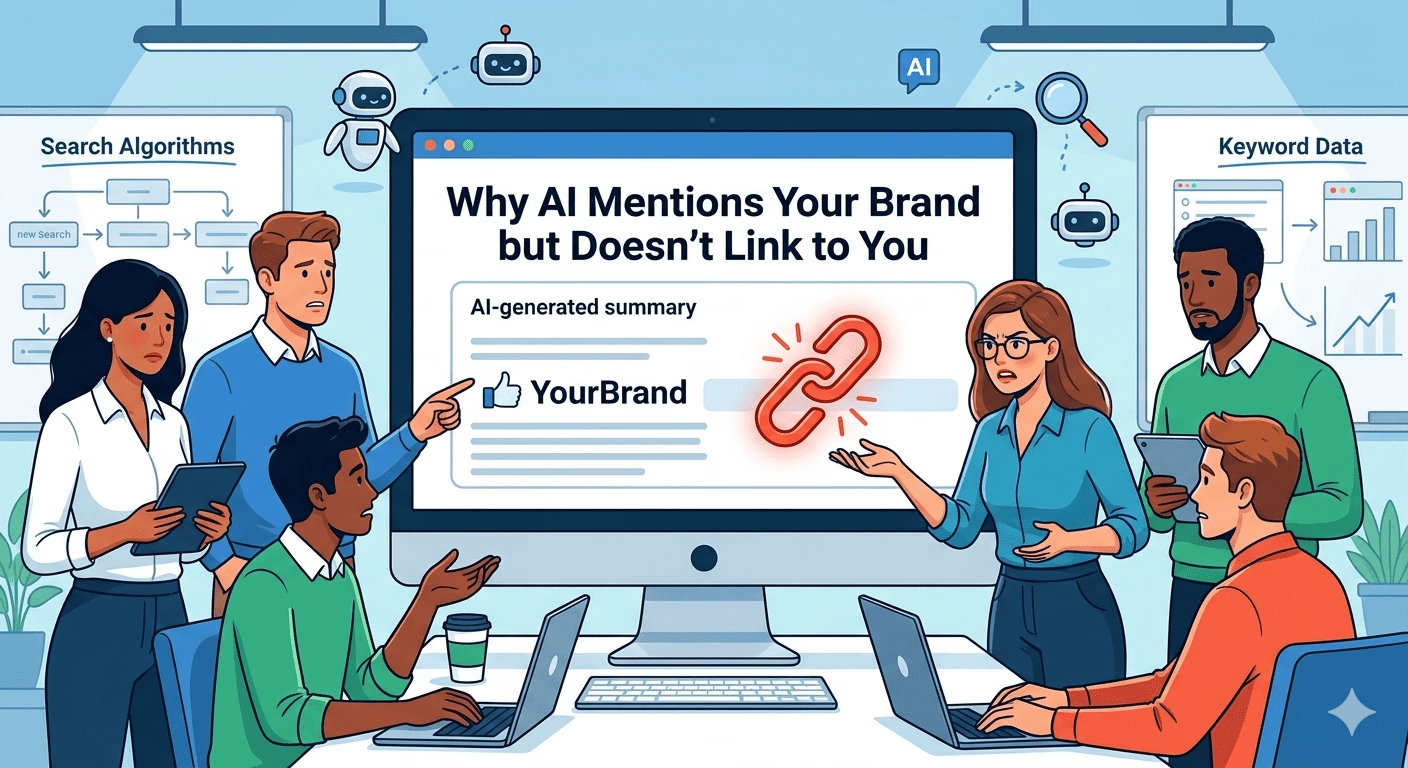
A brand citation is simply a mention of your brand name across the web — whether or not it includes a hyperlink. Google’s algorithms have become sophisticated enough to recognise and count these unlinked mentions as trust signals, and AI systems use them extensively when determining which sources to cite in generated answers.
Think about it from the AI’s perspective. If your brand is mentioned consistently across industry publications, news outlets, professional directories, and forum discussions, the AI builds a picture of a well-known, established entity. That entity is then more likely to be referenced in AI Overviews and generative search results.
We explored this in depth in our article on brand citations as a hidden SEO advantage, which includes practical strategies for building citation volume.
How to Build Brand Citations That Matter
- Contribute expert commentary to industry publications. Journalists and editors are constantly seeking expert sources. Platforms such as Connectively (formerly HARO), Qwoted, and direct media outreach can position your team as go-to commentators.
- Publish original research and data. When other sites reference your findings, they create brand citations naturally. Annual surveys, benchmarking studies, and market analyses are particularly effective.
- Maintain accurate and complete directory listings. Ensure your brand is consistently represented across relevant business directories, professional body listings, and industry aggregator sites.
- Engage in strategic co-marketing and partnerships. Joint webinars, co-authored reports, and partnership announcements naturally generate brand mentions across multiple audiences.
- Invest in thought leadership on LinkedIn and beyond. Regular, high-quality posts from your leadership team build brand recognition across professional networks and often get cited in third-party articles. Our guide to LinkedIn SEO for B2B leaders covers this in detail.
Structured Data: The Language AI Actually Understands
If there is one technical SEO element that has grown disproportionately in importance over the past year, it is structured data. Schema markup has evolved from a technical enhancement that helped you win rich snippets into a fundamental layer of communication between your website and AI systems.
Without structured data, your content is plain text that AI must interpret through inference. With structured data, you are providing explicit, machine-readable context about what your content is, who created it, what organisation it belongs to, and what topics it covers.
In an era where AI systems are selecting sources for generated answers, that explicit context can be the difference between being cited and being overlooked.
Our detailed guide on structured data for AI search provides a comprehensive walkthrough for professional services firms.
Essential Schema Types for 2026
At a minimum, every business website should implement the following schema types:
- Organisation schema on your homepage and About page, including your official name, logo, contact details, social profiles, and founding information.
- LocalBusiness schema (if applicable) with accurate address, opening hours, and service area information.
- Person schema on author and team profile pages, linking each person to their content and credentials.
- Article or BlogPosting schema on every piece of content, including author, publication date, modification date, and publisher information.
- FAQPage schema on pages that contain frequently asked questions — which, as it happens, AI Overviews particularly favour as source material.
- Service schema on your service pages, clearly defining what you offer, where, and to whom.
- BreadcrumbList schema to help search engines and AI systems understand your site hierarchy and content relationships.
Implementing schema is not glamorous work, but it is among the highest-ROI activities in modern SEO. And for firms in competitive sectors, it provides a measurable edge.
AI-Generated Content Policies: What Google Actually Penalises
There is still a great deal of confusion surrounding Google’s stance on AI-generated content. Let us set the record straight.
Google does not penalise content simply because it was created with the assistance of AI tools. What Google penalises is low-quality content that fails to serve users — regardless of how it was produced. The distinction is critical.
Google’s guidance is clear: content should demonstrate originality, provide genuine value, and serve a people-first purpose. If you use AI to help draft content that is then reviewed, fact-checked, refined, and enhanced by a knowledgeable human editor, that is perfectly acceptable. If you use AI to mass-produce thin, derivative content with no editorial oversight, you are inviting algorithmic penalties.
The practical implications for your content strategy are straightforward:
- Use AI as a tool, not a replacement for expertise. AI can help with research, outlining, drafting, and editing, but the strategic direction, original insights, and editorial quality must come from people with genuine subject matter knowledge.
- Every piece of published content should pass through human review. This means fact-checking claims, verifying statistics, ensuring the tone matches your brand, and adding the kind of nuanced insight that AI alone cannot provide.
- Prioritise depth and originality over volume. One meticulously crafted, expert-reviewed article will outperform ten rushed, AI-generated pieces every time — both in rankings and in AI citations.
- Be transparent where appropriate. There is no requirement to disclose AI assistance, but there is a growing expectation of transparency in certain sectors. Consider your audience and industry norms.
For those weighing the balance between AI tools and human expertise, our guide to the best free AI SEO tools explains how to use these technologies responsibly and effectively.
Voice Search and Visual Search: Growing Quietly but Steadily
Voice search and visual search do not attract the same attention as AI Overviews or GEO, but both channels are growing steadily and represent real opportunities for businesses willing to optimise for them.
Voice search queries now account for a meaningful share of mobile search activity, driven by the continued adoption of smart speakers, voice assistants on smartphones, and in-car systems. Visual search — using images rather than text to initiate a search — is gaining particular traction in sectors such as retail, property, hospitality, and design.
Optimising for Voice Search
- Write in natural, conversational language. Voice queries tend to be longer and more conversational than typed queries. Content that mirrors natural speech patterns is more likely to be selected as a voice search answer.
- Target question-based queries directly. Structure content around explicit questions and provide clear, concise answers in the opening sentences. FAQ sections are particularly effective here.
- Optimise for local intent. A significant proportion of voice searches have local intent (“best solicitor near me”, “accountant open now”). Ensure your local SEO is impeccable, with accurate business listings and location-specific content.
- Aim for featured snippet positions. Voice assistants overwhelmingly pull their spoken answers from featured snippets and AI Overviews. Structuring your content to win these positions directly improves voice search visibility.
Our full guide on getting your business found on voice search provides a comprehensive implementation plan.
Optimising for Visual Search
- Use descriptive, keyword-rich alt text on all images. This is the single most important factor for visual search discoverability.
- Implement ImageObject schema. This helps search engines understand the subject and context of your images beyond what alt text alone can convey.
- Use high-quality, original images. Stock photography is less likely to surface in visual search results. Original images of your work, team, or premises carry more weight.
- Ensure images are technically optimised. Proper file naming, appropriate compression, responsive sizing, and modern formats (WebP, AVIF) improve both load performance and search visibility.
For a thorough walkthrough, see our guide on optimising images for visual search.
Technical SEO Still Underpins Everything
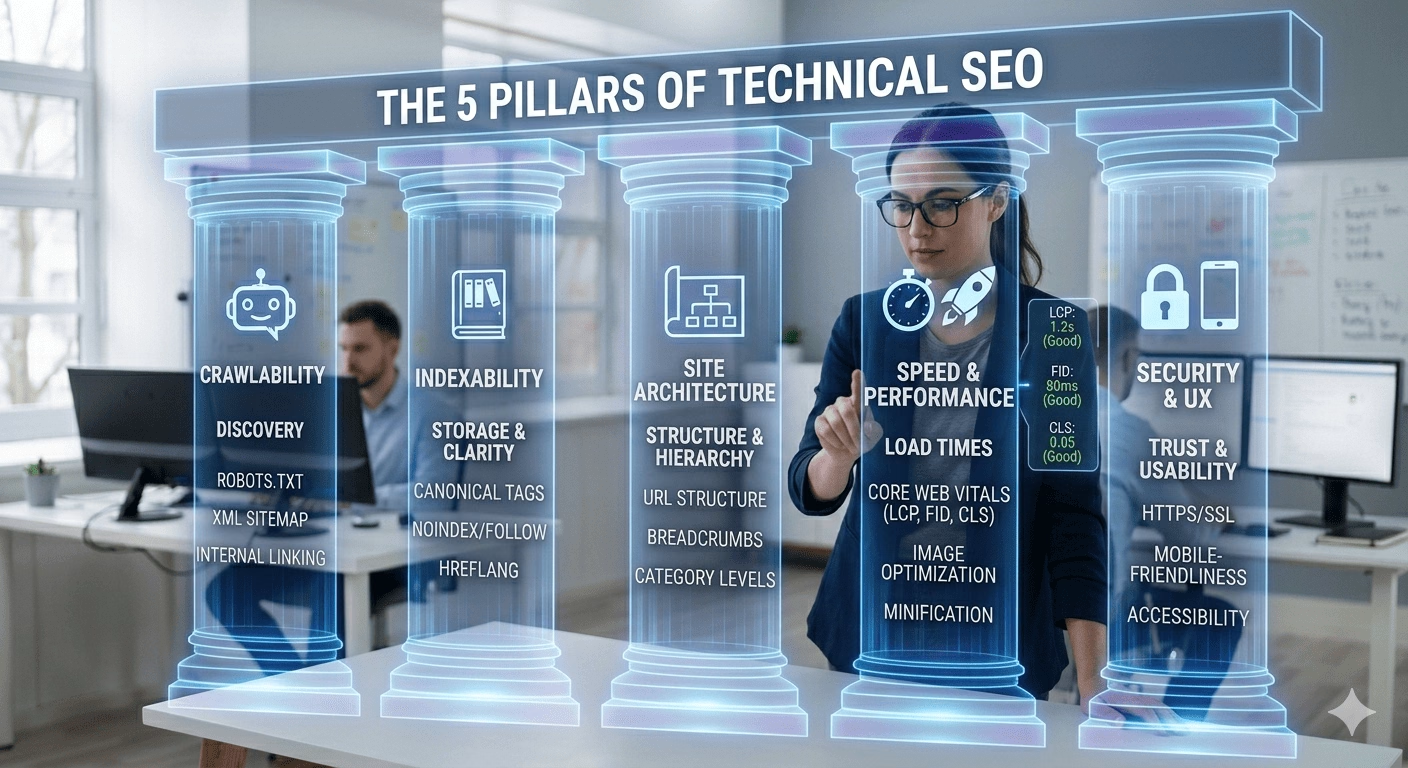
It would be a mistake to become so focused on AI optimisation and content strategy that you neglect the technical foundations of your website. In 2026, technical SEO remains as important as ever — arguably more so, because the stakes are higher.
If search engines cannot crawl, render, and index your content properly, no amount of entity SEO, schema markup, or topical authority will help. Your content simply will not exist in the eyes of the algorithms that select sources for AI-generated answers.
The fundamentals have not changed, but the consequences of getting them wrong have increased:
Your 2026 Technical SEO Checklist
- Core Web Vitals performance. Google’s page experience signals continue to influence rankings. Ensure your Largest Contentful Paint (LCP), Interaction to Next Paint (INP), and Cumulative Layout Shift (CLS) metrics are within acceptable thresholds. Our guide on improving Core Web Vitals provides actionable steps.
- Crawlability and indexation. Regularly audit your site for crawl errors, orphaned pages, and indexation issues using Google Search Console. Content that is not indexed does not exist. For troubleshooting, see our guide on website indexing.
- Site architecture and internal linking. A logical, flat site structure with clear internal linking hierarchies helps both crawlers and AI systems understand your content relationships.
- Mobile performance. Mobile-first indexing has been the standard for years, but mobile performance is still an area where many sites fall short. Test regularly and address issues promptly.
- HTTPS and security. Non-secure sites face both ranking penalties and user trust issues. Ensure your SSL certificate is properly configured and all resources load over HTTPS.
- XML sitemaps and robots.txt. These may seem basic, but misconfigured sitemaps and robots.txt files remain among the most common technical SEO errors we encounter in audits.
For a comprehensive walkthrough of technical SEO fundamentals, our technical SEO optimisation guide covers everything you need.
Measuring SEO Success in 2026
The metrics that defined SEO success five years ago — keyword rankings, organic sessions, bounce rate — are no longer sufficient on their own. In 2026, a mature SEO measurement framework must account for the new realities of search.
Here is what you should be tracking:
- Traditional organic metrics. Keyword rankings, organic traffic, click-through rates, and conversion rates remain important. Do not abandon them — augment them.
- AI Overview and featured snippet presence. Monitor how frequently your content appears in AI-generated answers and which queries trigger your citations. Tools such as Semrush, Ahrefs, and specialist platforms now offer AI visibility tracking.
- Brand mention volume and sentiment. Track how often and where your brand is mentioned across the web. Tools like Brand24, Mention, and Google Alerts can help, but more sophisticated monitoring is increasingly necessary.
- Entity recognition in Knowledge Graph. Check whether Google recognises your brand as a Knowledge Graph entity and monitor the accuracy of the information displayed.
- Topical authority scores. Several SEO platforms now provide topical authority metrics that indicate how comprehensively your site covers specific subject areas relative to competitors.
- Referral traffic from AI platforms. Monitor traffic coming from ChatGPT, Perplexity, Gemini, and other AI tools. This is a growing traffic source that many analytics setups currently do not track properly.
- Direct and branded search volume. An increase in branded searches is a strong indicator that your visibility across AI platforms is driving recognition and recall, even when it does not produce immediate clicks.
The businesses that will thrive in this environment are those that look beyond any single metric and understand the interconnected nature of modern search visibility.
Frequently Asked Questions
What is the single most important SEO trend in 2026?
Is traditional keyword-based SEO dead?
What is Generative Engine Optimisation (GEO)?
Does Google penalise AI-generated content?
How do I get my brand mentioned in AI Overviews?
What is entity SEO and why does it matter?
How often should I update my SEO strategy?
What to Do Next
The SEO trends of 2026 are not theoretical. They are shaping results pages, influencing buying decisions, and rewarding businesses that adapt — right now.
If this article has highlighted gaps in your current strategy — whether that is a lack of structured data, an underdeveloped entity profile, or a content approach that has not kept pace with AI search — then the time to act is now. Not next quarter. Now.
At Agile Digital Agency, we help professional services firms across the UK navigate precisely these challenges. From comprehensive SEO audits and GEO readiness assessments to full content strategy development and technical implementation, we work as an extension of your team to deliver measurable results.
Ready to future-proof your search visibility?
Submit your SEO brief and let us show you what is possible. Or if you prefer a conversation first, get in touch directly — we would be glad to talk through your specific situation.

Related
Articles
![What Is Entity-Driven SEO? A Practical Guide for Professional Services [2026]](https://www.agiledigitalagency.com/wp-content/uploads/2026/03/What-Is-Entity-Driven-SEO-1.avif)