Keyword Research: A Simple, Effective Process for 2026
Struggling to choose the right keywords for your website? You are not alone. The good news is that a clear, step‑by‑step process can turn keyword research from guesswork into a predictable way to attract the right visitors and enquiries.
For 2026, keyword research becomes less about “finding phrases” and more about building semantic topic authority that performs across AI Overviews, AI Mode, and classic blue-link SERPs.
In this article:
What is keyword research?
Keyword research is the process of discovering the words and phrases people type or speak into search engines when they are looking for information, services, or solutions. Done well, it helps you plan content that meets real needs, builds trust, and supports your wider SEO and marketing strategy.
Put simply: right keywords, right pages, right people.
Why keyword research matters in 2026
Search is changing fast. AI‑powered results, richer search features and stricter quality expectations mean you can no longer rely on a few obvious phrases and hope for the best. Instead, you need a focused keyword strategy that:
- Reflects how your ideal clients actually talk about their problems.
- Covers topics in depth, not just single phrases.
- Works across traditional results, AI Overviews and voice‑style queries.
If you get this right, you make it easier for search engines to understand your expertise and easier for users to find exactly what they need.
Read also: The Best FREE AI Tools to Boost your SEO Efforts
Step 1: Start with your audience and problems
Before you open any tools, start with people.
Ask:
- Who are your main customer types?
- What problems do they face before they contact you?
- What words do they use when they describe those problems?
Practical tip:
- Review recent emails, contact forms, support tickets and call notes.
- Highlight repeated phrases and questions.
- Turn each into a simple “topic” (for example, “but traditional Scottish sweets online”, “no win no fee accident claims St. Louis”).
This gives you a human‑centred list of topics before you even think about volumes and difficulty.
Google Trends is an invaluable tool for tracking whether there have been recent surges or declines in searches for your target keywords. Bing has a similar tool to research keyword trends.
Step 2: Understand search intent
Now, here is the key: Not every searcher wants the same thing.
Search intent describes what someone is trying to achieve when they search. In 2026, matching intent is one of the strongest signals that your content is genuinely useful.
The main intent types are:
- Informational: The user wants to learn. Example: “how does J‑1 visa sponsorship work”.
- Navigational: The user wants a specific site or brand. Example: “Agile Digital Agency services”.
- Commercial research: The user is comparing options. Example: “best SEO tools for small business UK”.
- Transactional: The user is ready to act. Example: “local SEO agency in London” or “no win no fee solicitor Manchester”.
Quick exercise:
- Search your candidate keyword.
- Look at the top 5–10 results.
- Ask: are they guides, comparison pieces, or service pages?
Your page should usually match the dominant type.
Step 3: Build topic clusters, not isolated keywords
Here is where most small businesses go wrong: They chase single keywords instead of building a full picture of a topic.
A topic cluster is a group of related pages that cover one area of expertise in depth: one main “pillar” page plus several focused supporting articles and FAQs. This structure helps search engines recognise your authority and makes your website easier to navigate.
For each main topic from Step 1:
- Create a pillar page (for example, “Complete Guide to Negligent Security Claims in Atlanta”).
- Plan supporting content that answers specific questions and sub‑topics.
- Link all relevant pages together in a logical way.
Think of clusters as your long‑term foundation rather than standalone blog posts.
Step 4: Use tools to expand your keyword ideas
Now it is time to open your tools.
Use a mix of:
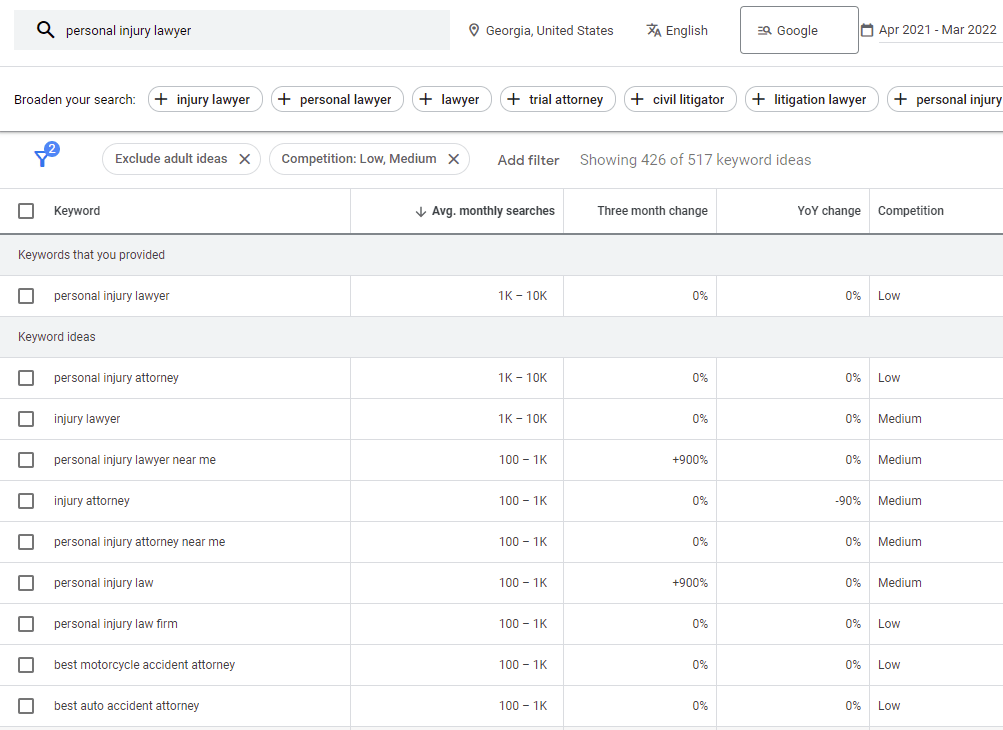
- Traditional keyword tools (such as Google Keyword Planner, Ahrefs, Semrush, Ubersuggest).
- Question and idea tools (such as AnswerThePublic, Answer Socrates, forum and Q&A sites).
- AI‑assisted tools that suggest related phrases, entities and questions.
Focus on:
- Search volume ranges (is there enough interest for your niche?).
- Relative difficulty (can a site like yours realistically compete?).
- Variations and long‑tail phrases that show clearer intent and lower competition.
Remember: tools provide clues, not absolute truth. Always check the live search results to confirm what users see.
Step 5: Optimise for modern SERP and AI features
Search results are no longer just ten blue links.
Today’s results can include:
- AI Overviews and AI Mode summaries.
- Featured snippets and “People Also Ask” boxes.
- Local packs, knowledge panels and more.
Your process should include:
- Checking whether key queries show AI‑style summaries or snippets.
- Noting which subtopics, questions and entities are highlighted.
- Making sure your content clearly answers those questions in plain, well‑structured language.
Clear headings, short paragraphs and direct answers give you a better chance of appearing in these high‑visibility spots.
Step 6: Evaluate and prioritise your keyword list
At this point, your list will be long.
Here is where you narrow it down.
For each keyword or group of closely related phrases, consider:
- Intent match: Does it truly fit what your business offers and what the user expects?
- Search volume: Is there enough interest to justify a dedicated page or section?
- Difficulty: How competitive is the term and how strong are the sites already ranking?
- Business value: If you rank for this, how likely is it to lead to enquiries or sales?
- Role in the cluster: Does it support an existing pillar or justify a new one?
You can keep this simple with a 1–3 score for each factor and prioritise the highest totals.
Step 7: Map keywords to pages and funnel stages
Now comes a important step many people skip.
Every important keyword (or group of very similar keywords) must have a clear “home” on your website. That home could be:
Also, think about the buyer journey:
- Top of funnel: broad, informational queries.
- Middle of funnel: comparison and solution‑aware queries.
- Bottom of funnel: geo‑specific and transactional queries.
This mapping avoids duplication and helps you design internal links that guide users towards contact or purchase.
Step 8: Create content that shows real expertise
Here is the bottom line: Search engines want content written for people, by people with real experience.
For your most important keywords:
- Explain processes in practical, concrete steps.
- Share relevant examples, scenarios, or anonymised case insights.
- Use clear authorship, short bios, and, where appropriate, date and update information.
Where possible, highlight:
- Results achieved (for example, growth in organic leads or rankings).
- Specialisation in your niche (for example, legal services, visa sponsorship, local professional services).
This supports E‑E‑A‑T (Experience, Expertise, Authoritativeness, Trustworthiness) and sets you apart from generic AI‑generated content.
Step 9: Avoid common keyword research mistakes
To keep your strategy healthy, watch out for these pitfalls:
- Chasing only high‑volume, high‑competition terms while ignoring long‑tails that convert better.
- Ignoring search intent and trying to rank a service page for an informational query.
- Copying competitors’ keywords without checking if they fit your services or audience.
- Overusing keywords in titles, headings or body copy so the text sounds unnatural.
- Neglecting meta titles, meta descriptions and internal links.
- Failing to review and update your keyword strategy as search behaviour and SERPs change.
Keeping these in mind helps you build sustainable traffic rather than a short‑lived spike.
Step 10: Maintain and refine your keyword strategy
Keyword research is not a one‑off task.
Plan to:
- Review performance in tools such as Google Search Console and your rank tracker every quarter.
- Identify keywords where you are close to page one and improve content and internal links.
- Add new topics based on new regulations, services, or common client questions.
This ongoing refinement keeps your site aligned with real demand and emerging opportunities such as zero‑volume and predictive queries.
How Agile can support your keyword strategy
Keyword research can feel overwhelming when you are also trying to run a business.
Agile Digital Agency helps professional services and small businesses turn keyword data into clear, effective content plans that support real commercial goals. This includes:
- Audience and intent discovery sessions.
- Topic cluster and site structure planning.
- Keyword research built for your niche and location.
- Content briefs and on‑page optimisation that follow best practice for your target audience.
If you would like your existing content and keyword strategy reviewed, you can request a structured audit and roadmap that you can implement in‑house or with our support.

Our commitment to excellence is showed by our recognition as a Top SEO company in the United Kingdom for Business Services.
Frequently Asked Questions
How has keyword research changed with AI search engines?
In the AI search era, keyword research must go beyond search volume and competition. You now need to consider how AI engines interpret and group topics, prioritise questions and conversational queries that trigger AI Overviews, focus on building topical authority through clusters rather than targeting isolated keywords, and ensure your content answers queries comprehensively enough to be cited by AI.
What are the best free keyword research tools in 2026?
Google Keyword Planner remains the most reliable free option for search volume data. Google Search Console shows actual queries driving impressions. Google Trends reveals seasonal patterns and rising topics. AnswerThePublic surfaces question-based queries. Ubersuggest offers limited free searches. For AI-specific keyword research, analysing what queries trigger AI Overviews in Google is increasingly valuable.
How many keywords should I target per page?
Focus on one primary keyword and two to four closely related secondary keywords per page. In 2026, search engines understand semantic relationships well enough that you should write naturally about a topic rather than forcing multiple exact-match keywords. Topical depth matters more than keyword density.
What is search intent and why does it matter for keyword research?
Search intent is the underlying purpose behind a search query – whether someone wants information (informational), to find a specific site (navigational), to compare options (commercial), or to make a purchase (transactional). Matching your content type and format to search intent is arguably more important than the keyword itself, as misaligned content won’t rank regardless of optimisation.
Should I still target long-tail keywords in 2026?
Absolutely. Long-tail keywords (specific, lower-volume phrases) have become even more valuable in 2026. They often trigger AI Overviews and featured snippets, face less competition, attract higher-intent visitors, and align well with voice search queries. For professional services firms, long-tail keywords like ‘SEO agency for law firms London’ convert far better than broad terms like ‘SEO agency’.

Related
Articles