Digital Marketing BlogWhat AI Assistants Say They Weigh When They Rank Law Firms
What AI Assistants Say They Weigh When They Rank Law Firms
We asked three AI assistants the question a prospective client asks: which personal-injury firm in this city should I instruct? Then we asked each one to show its working. All three volunteered a scoring formula, with weights, and named the sources they would draw on. The answers were more consistent than we expected.
One caution before the numbers. What follows is what Perplexity, Gemini and ChatGPT say they would weigh when asked to explain themselves: the assessment frameworks each one generated, not the internal mechanics of any of them. Read the weights as stated preferences, not measured ranking factors. Each assistant was asked once, about personal-injury firms in the same US city, to compare them and then show its scoring; we come back to the limits at the end. Even so, when three systems built by three companies independently put the same things at the top and the same thing at the bottom, that is worth knowing before you spend another pound on your website.
In this article:
The short version
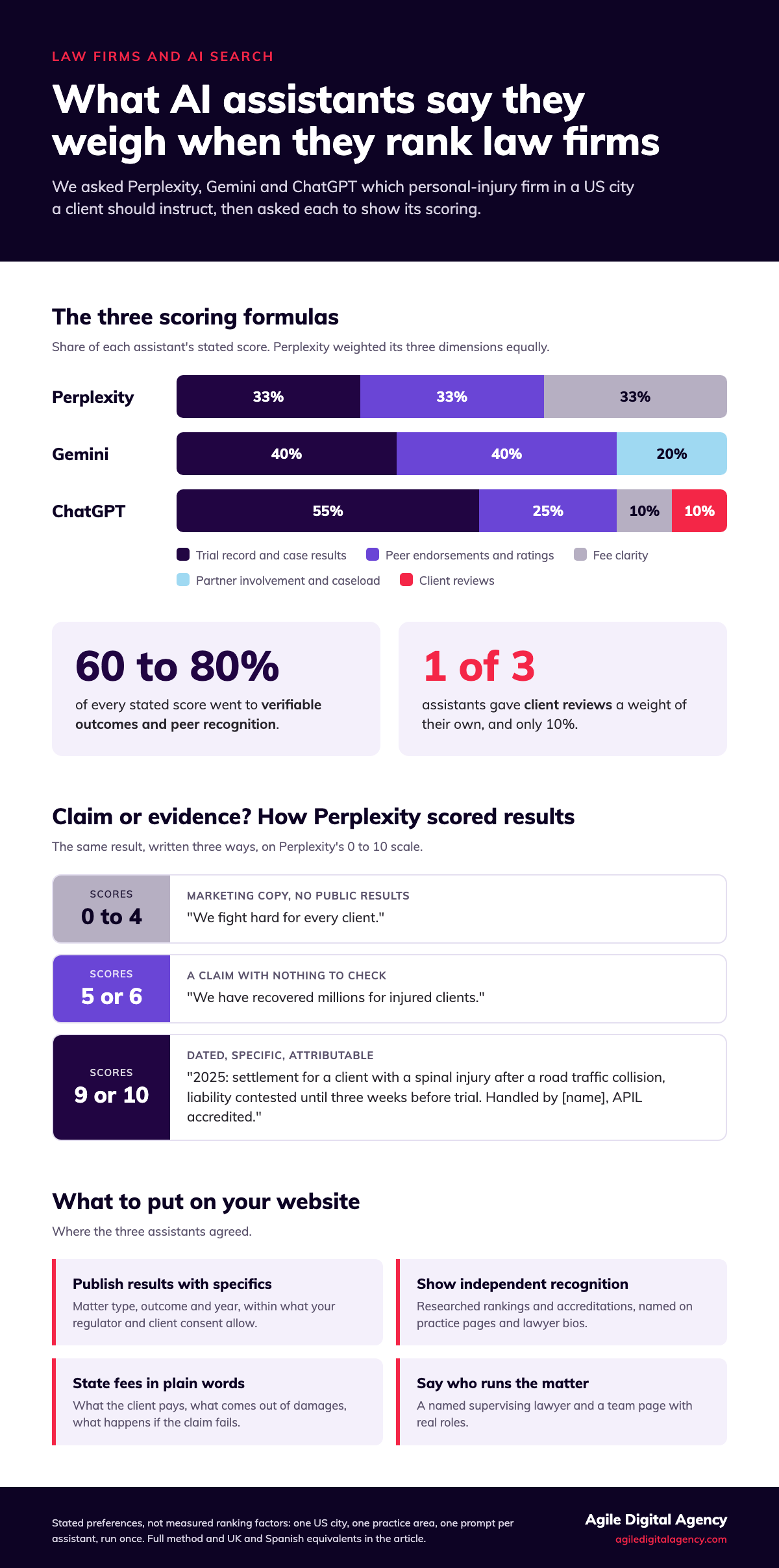
Asked to compare law firms, all three assistants put verifiable outcomes and peer recognition at between 60% and 80% of their stated scores. Only ChatGPT gave client reviews a weight of their own, 10%; Perplexity and Gemini left them out of their formulas. All three favoured specifics over claims, independent recognition over badges, and plain statements about fees and who runs the matter. If your website leads with star ratings and “millions recovered”, it leads with what the assistants said they weigh least.
What each assistant said it would measure
The exercise used one US city and one practice area, personal injury, so the vocabulary is American: jury verdicts, contingency fees, state bar honours. The structure of the answers is what travels. Here are the three formulas side by side.
| Signal | Perplexity | Gemini | ChatGPT |
|---|---|---|---|
| Trial record and case results | 33% | 40% | 55% (35% trial record, 20% case results) |
| Peer endorsements and ratings | 33% | 40% | 25% |
| Fee clarity | 33% | not scored separately | 10% |
| Operating model and partner involvement | not scored | 20% | not scored |
| Client reviews | not scored | not scored | 10% |
Perplexity scored each dimension from 0 to 10 and averaged them. Its bands are the most instructive part of the whole exercise. Specific, high-value verdicts with documented results scored 9 or 10. General “millions recovered” language with no specific outcomes scored 5 or 6. Marketing copy with no public results at all scored 0 to 4. The same scale applied to fees: a clearly stated percentage, free consultation and written terms scored at the top; vague fee language scored in the middle; unclear arrangements scored at the bottom.
Gemini was explicit that it prefers verifiable jury verdicts to out-of-court settlements, and that it reads partner involvement and caseload per lawyer as a signal of whether a firm is a boutique or a volume operation. In practice that signal can only come from what a firm publishes: team pages with real roles, a named supervising lawyer for each practice area, and how the firm describes its caseload. A volume practice and a specialist boutique will score differently on it, so read that 20% against your actual model. ChatGPT built a 100-point score and was equally explicit about why it would not simply average the inputs: the question it is trying to answer is who is demonstrably strong, not who has the happiest reviewers.
Where the three agree
- Evidence beats assertion. Every formula distinguishes between a documented result and a claim about results. “Millions recovered” is a claim. A dated verdict with a figure is evidence. The assistants scored them differently, and so should you when you write a results page.
- Independent recognition outweighs promotional claims. All three leaned on recognition backed by independent assessment rather than what a firm says about itself, and Gemini said outright that it sources peer data from platforms that restrict self-nomination and paid placement. Not every award carries the same weight: an editorial ranking built on research, client feedback and peer interviews is a different kind of evidence from a paid directory profile or a badge bought for marketing. Be clear about what each recognition you display actually represents.
- Clarity is scored. Fee terms, who handles the matter, how to get started. Two of the three gave these their own line in the formula, and the third folded them into its operating-model score. Vagueness costs points even when the underlying service is good.
Why client reviews count for so little
This is the finding most firms will find uncomfortable, because reviews are where most of the marketing effort goes. ChatGPT gave client reputation 10% of its score. Perplexity and Gemini did not give reviews a separate weight; in their explanations reviews appeared as context, not as evidence of legal capability. That is not the same as saying reviews have no influence on a live answer, only that none of the three put them near the top when asked. ChatGPT’s reasoning was that it is trying to establish who is demonstrably strong, not who has the happiest reviewers, and a thousand five-star reviews answer the second question, not the first.
That does not make reviews worthless. They still drive the Google local pack, they still reassure a visitor who has already shortlisted you, and a firm with a 3.8 rating has a different problem. But if you are deciding where the next hour of marketing time goes, these frameworks suggest that evidence of legal expertise and independent recognition is a higher priority than the next ten reviews.
The sources they named, and the UK and Spanish equivalents
Because the exercise was American, the assistants named American sources. The useful question for a firm in London, Manchester or Madrid is what plays the same role here. The mapping below is ours, not the assistants’. The entries in each row are not interchangeable: independently researched rankings, professional accreditations and published judgments are different kinds of evidence, and the table groups them by the job they do, not by equal weight.
| Signal | Sources the assistants named | UK equivalents | Spain equivalents |
|---|---|---|---|
| Independently researched rankings | Martindale-Hubbell AV Preeminent, Best Lawyers, Super Lawyers | Chambers and Partners, The Legal 500, Best Lawyers UK (editorial rankings, separate from paid profiles) | Chambers Europe, The Legal 500 EMEA, Best Lawyers España |
| Peer endorsements from other lawyers | Avvo lawyer endorsements | Referee and peer feedback gathered for the Chambers and Legal 500 research | Best Lawyers España peer votes; referee feedback in Chambers and Legal 500 |
| Accreditation and selective recognition | Million Dollar Advocates Forum, American College of Trial Lawyers | Law Society accreditation schemes for the practice area; APIL accreditation for claimant injury work; King’s Counsel, for advocates only | Recognised specialist titles and certifications; roles in Colegio de Abogados specialist sections (membership alone is not recognition) |
| Verifiable outcomes | Reported jury verdicts and settlements | Judgments, findable on BAILII and The National Archives’ Find Case Law; settlements only where the client consents and confidentiality allows | Judgments on CENDOJ; settlements only with client consent and within the Código Deontológico |
| Fee clarity | Stated contingency percentage, free consultation, written terms | Plain conditional-fee and damages-based terms: what the client pays, what comes out of damages, what happens if the claim fails. SRA price rules cover specified services only, not personal injury | Hoja de encargo setting out honorarios and costs; clear terms for any success-fee element |
| Who runs the matter | Partner involvement, caseload per attorney | Named fee earner, supervising partner, team page with real roles | Abogado responsable named, team page with colegiado numbers |
Two things stand out in the UK column. Chambers and The Legal 500 build their rankings from submissions, referee interviews and their own research, which makes them exactly the kind of independent evidence that can substantiate a firm’s claims. Whether and how a given assistant draws on them is a separate question; their value as credentials is not in doubt. And on fees, the SRA Transparency Rules require published price information only for specified services, and personal injury is not one of them. Most injury firms therefore publish nothing that matches what the assistants said they reward. Explaining in plain words what the client pays under a conditional-fee agreement, what can be deducted from damages and what happens if the claim fails is voluntary, which is why it is so often missing.
What this means for your firm
None of this requires new marketing. It requires putting the right evidence where the assistants, and the prospective clients who ask them, can find it.
- Publish results with specifics. A results page that states the matter type, the outcome and the year, within what your regulator and client consent allow, scores at the top of every formula. “Millions recovered” scores in the middle. Nothing scores at the bottom.
- Put independent recognition on the site, not just in the cabinet. Chambers and Legal 500 rankings, Law Society and APIL accreditations, Best Lawyers listings. Name them on the relevant practice pages and in the lawyer bios, and mark them up with structured data where the schema supports it. Markup helps machines read a credential correctly; it does not make the credential carry more weight.
- State fees in plain words, and link to them. If you publish prices for services the SRA rules cover, make that page reachable from every service it applies to. For conditional-fee work, which the rules do not cover, say what the client pays, what can be deducted from damages and what happens if the claim fails. Vagueness is scored, and not in your favour.
- Say who does the work. Gemini gave a fifth of its score to partner involvement and caseload. A team page with real roles, a named supervising lawyer on each practice page, and bios that say what each person actually handles, answers that question directly.
- Make the rest of the web tell the same story. Your website is one side of the evidence. Assistants also read the directories, accreditation registers, court records and press that mention you, and they check them against each other. A strong record that appears only on your own site is harder to verify than one independent sources repeat, and practice areas, people and credentials that differ between sources get discounted. That is the entity-clarity work in our guide to trust signals for law and finance firms, and the first lever in the AI Visibility Score.
Claim or evidence? The same result, written three ways:
- Scores low: “We fight hard for every client.” No evidence at all.
- Scores in the middle: “We have recovered millions for injured clients.” A claim with nothing to check.
- Scores high: “2025: settlement for a client with a spinal injury after a road traffic collision, liability contested until three weeks before trial. Handled by [name], APIL accredited.” Dated, specific and attributable, and published with the client’s consent.
If you are rebuilding the site, the same priorities should shape the structure from the start: see what a law firm website needs to do.
What this evidence is, and is not
This was one city, one practice area and one prompt per assistant, run once. The assistants were asked to explain how they would assess competing firms, not to reveal their ranking systems, and models are not always reliable narrators of their own behaviour. A different prompt, or a newer model version, could produce a different formula. We would not build a strategy on this alone.
What makes it useful is the convergence. Asked separately, three systems built by three companies described the same hierarchy: demonstrable results, independent recognition and clear information about how a firm works. That is a sensible starting point. It does not tell you whether your firm is the one being recommended, which takes a different kind of test, and it is the one we would run next:
- Ask the same client questions in several phrasings, across assistants, from your market.
- Record whether your firm is named, cited as a source, or recommended, which are three different things.
- Note which domains the assistants cite, for you and for the firms named instead.
- Compare before and after publishing specific outcomes, credentials and fee information.
- Repeat it over time rather than trusting one answer.
The hierarchy above is consistent with what we see when we measure how often firms are actually named across hundreds of real answers. The self-reports tell you where to look. The measurement tells you whether it worked.
The findings on one page
The three formulas, the claim-to-evidence scale and the four changes that matter, in one image. You are welcome to share it or use it in your own writing, with a link back to this article.
To embed it on your site, copy this code:
<a href="https://www.agiledigitalagency.com/blog/how-ai-assistants-rank-law-firms/"><img src="https://www.agiledigitalagency.com/wp-content/uploads/2026/10/agile-ai-assistants-law-firm-ranking-infographic.png" alt="Infographic: what Perplexity, Gemini and ChatGPT said they weigh when ranking law firms, with outcomes and peer recognition at 60 to 80% and client reviews at 10% or less" width="1200" height="2416" style="max-width:100%;height:auto" loading="lazy"></a>
<p>Source: <a href="https://www.agiledigitalagency.com/blog/how-ai-assistants-rank-law-firms/">Agile Digital Agency</a></p>
FAQ
Do AI assistants use Google reviews to rank law firms?
Not much, by their own account. Asked to explain their scoring, ChatGPT gave client reviews 10% of the weight, and Perplexity and Gemini did not give them a separate weight at all. All three put verifiable outcomes and peer recognition far ahead. That is what they said when asked, not a measurement of live answers, and reviews still matter for Google’s local results and for reassuring visitors who have already shortlisted you.
Which legal directories did the AI assistants name?
Independently researched ones, where lawyers and clients assess other lawyers and placement in the ranking cannot be bought. In the US exercise the assistants named Martindale-Hubbell, Best Lawyers, Super Lawyers and Avvo peer endorsements. The closest UK equivalents are Chambers and Partners, The Legal 500 and Best Lawyers UK, with accreditations such as APIL’s for injury work as a separate kind of evidence; in Spain, Chambers Europe, The Legal 500 EMEA and Best Lawyers España.
Does this apply to UK and Spanish law firms?
The structure does, the sources do not. The assistants reward specific published outcomes, peer-reviewed recognition, clear fees and a named person running the matter wherever the firm is. The directories and rules differ by country, which is why the article maps each US source to its UK and Spanish counterpart. The honest caveat is that this is what the assistants say they weigh; the only way to know how your firm is actually faring is to measure it.
Is AI recommending your law firm?
AI Visibility Monitoring asks ChatGPT, Perplexity and Google’s AI Overviews and AI Mode the questions your prospective clients ask, from your market, repeated enough times to give a rate rather than a screenshot. It reports how often your firm is named, which competitors appear alongside you, and which sources the assistants cite when they recommend you or a competitor.

Related
Articles