
Ultimate Guide to AI-First SEO for Professional Services
SEO Has Changed — And Professional Services Must Change With It
Search engines are no longer just ranking blue links. They’re generating answers. Summarising content. Recommending brands. Interpreting context.
And here’s the important bit:
Professional services firms — law firms, financial advisers, consultants, SaaS providers — operate in trust-based markets. Which means visibility in AI search isn’t optional.
It’s strategic positioning.
So in this guide, we’re going to break down:
- What AI-First SEO actually means
- Why professional services must approach it differently
- How to implement it practically
- And how to measure success in an AI-driven search environment
Ready?
Let’s dive in.
What Is AI-First SEO?
AI-First SEO is the practice of structuring your digital presence so that:
- Search engines understand your expertise
- AI systems can confidently reference your brand
- Your content is cited, summarised and surfaced in generative answers
In other words…
It’s not just about ranking.
It’s about being understood.
If you’re new to the concept of generative optimisation, start with our article on “Beyond SEO: A Practical Introduction to Generative Engine Optimisation (GEO)” — it explains how AI search differs from traditional ranking models.
Why Professional Services Need a Different Approach
Here’s the reality.
Professional services rely on:
- Credibility
- Authority
- Specialisation
- Reputation
AI systems look for the same signals.
That’s why brand citations, structured data, author expertise and entity clarity matter more than ever.
If you haven’t read it yet, our article “The Hidden SEO Advantage No One Talks About: Brand Citations” explains why mentions across the web can now be as important as backlinks.
Because here’s what’s happening: AI engines aren’t just crawling pages. They’re mapping entities. And your firm needs to be one.
The Five Pillars of AI-First SEO
Let’s break this down properly.
Not theory. Implementation.
1. Entity Clarity
AI needs to understand:
- Who you are
- What you specialise in
- Where you operate
- Who your experts are
That means consistent brand naming, structured data, author profiles and clearly defined services.
If entity SEO is new to you, read “Advanced GEO: Mastering Generative Engine Optimisation” for deeper context.
Because here’s the shift: Keywords signal relevance. Entities signal meaning.
And AI prioritises meaning.
2. Structured Data (Schema Markup)
This is where most firms fall short.
Structured data helps search engines and AI interpret:
- Articles
- FAQs
- Authors
- Organisations
- Services
Without schema, your content is just text.
With schema, it becomes structured knowledge.
For implementation guidance, see our deep-dive on structured data for AI search.
Quick wins include:
- Organisation schema on homepage
- Person schema on author pages
- Article schema on blog posts
- FAQ schema on service pages
Simple adjustments.
Serious impact.
3. Topical Authority Through Clusters
AI doesn’t trust isolated blog posts.
It trusts subject mastery.
And subject mastery isn’t demonstrated through volume.
It’s demonstrated through structure.
That’s where topic clusters come in.
Instead of publishing disconnected articles around loosely related keywords, your content should revolve around clearly defined core themes — supported by structured internal linking and semantic alignment.
Here’s what that looks like in practice:
- One comprehensive pillar page defining the subject
- Multiple in-depth supporting articles exploring subtopics
- Consistent terminology across all pieces
- Internal links reinforcing hierarchy and relevance
This creates a knowledge framework.
Not just content.
Because from an AI perspective, clusters signal:
- Topical consistency
- Depth of expertise
- Clear entity relationships
- Intent alignment
In other words…
You’re not just writing about a topic.
You’re owning it.
If you want a step-by-step breakdown of how to build effective pillar pages and cluster structures — including internal linking rules and semantic reinforcement — see our detailed guide on building topic clusters that AI will reward.
4. Technical SEO Still Matters (More Than You Think)
Here’s a common myth:
“AI search makes technical SEO irrelevant.”
Not true.
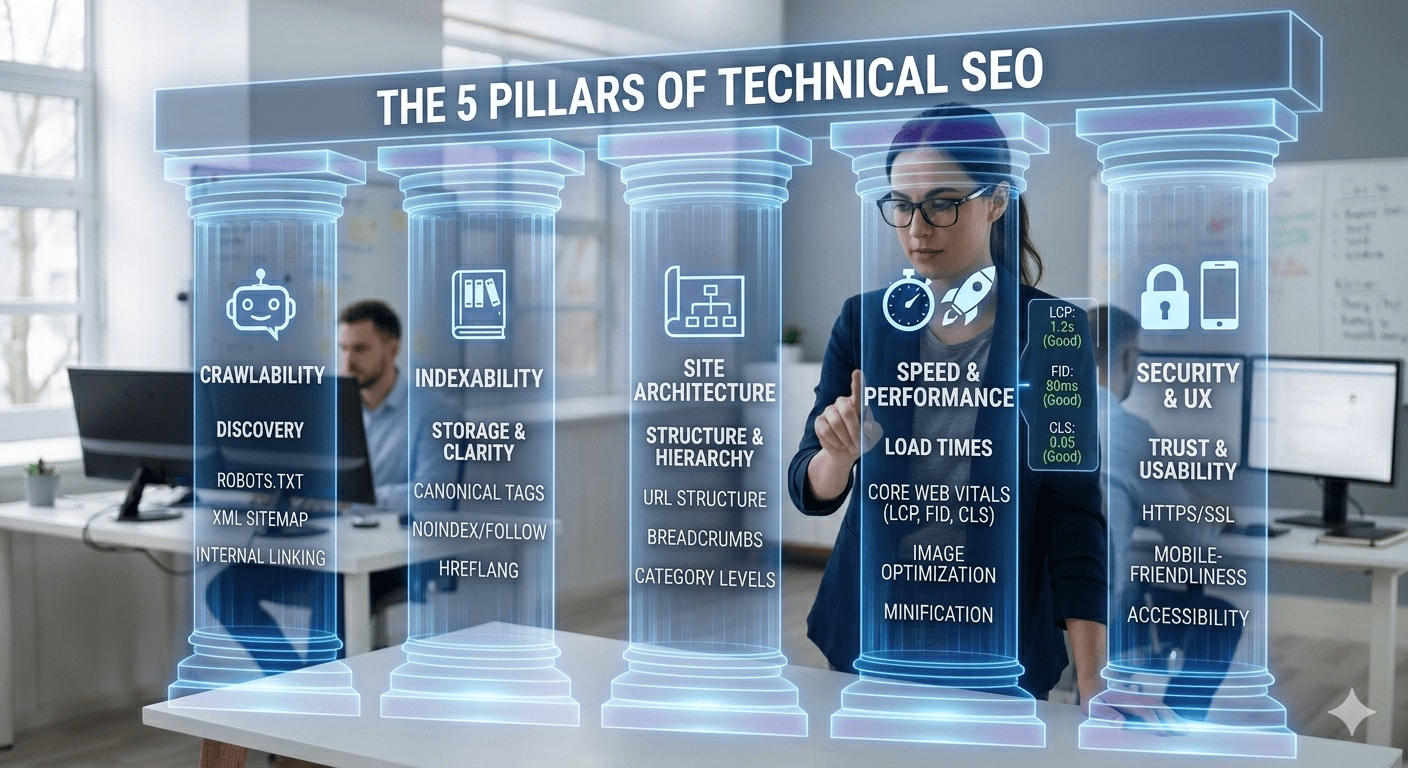
If your site is slow, poorly indexed or full of crawl errors, AI systems may never surface your content properly.
Foundational posts like:
- Technical SEO Optimisation: An Up-to-Date Guide for Small Businesses
- Core Web Vitals: Learn How to Improve for Better SEO [2026]
- Website Indexing: The Gateway to SEO Visibility
…remain essential reading.
Because AI can’t reference what it can’t access.
5. Brand Authority & Citations
This is where AI-First SEO becomes strategic.
Mentions across:
- Industry publications
- Directories
- Interviews
- Research reports
…build your entity profile.
And AI systems recognise that.
If you want to see this in action, read “From Invisible to Irresistible: How Brands Are Winning in AI-Powered Search”.
Visibility today isn’t just about traffic.
It’s about narrative dominance.
How to Implement AI-First SEO (Step-by-Step)
Let’s make this practical.
Step 1 — Audit Your Entity Presence
- Is your organisation schema implemented?
- Are authors defined?
- Are services clearly structured?
Step 2 — Build a Topic Map
Identify 3–5 core themes.
Create pillar pages.
Support them with cluster articles.
Step 3 — Strengthen Technical Foundations
Run Search Console audits.
Improve Core Web Vitals.
Fix indexing issues.
If you’re unsure how, start with our guide on Google Search Console errors.
Step 4 — Build Brand Citations
Pitch expert commentary.
Publish thought leadership.
Contribute to authoritative platforms.
Consistency builds recognition. Recognition builds authority. Authority builds AI visibility.
Measuring Success in an AI Era
Traditional KPIs:
- Rankings
- Traffic
- Click-through rate
Still matter.
But now you should also monitor:
- AI overview visibility
- Brand mention frequency
- Citation presence in generative responses
- Entity strength across platforms
Because the future of SEO isn’t position one.
It’s position everywhere.
Frequently Asked Questions
What is AI-First SEO?
AI-First SEO focuses on optimising your digital presence so AI systems can understand, cite and recommend your brand — not just rank it.
Is traditional SEO still relevant?
Absolutely. Technical foundations and keyword research still matter, but they must support a broader entity-based strategy.
What is GEO?
Generative Engine Optimisation (GEO) is the practice of optimising content for AI-generated search experiences.
Final Thoughts
Professional services operate in high-trust markets.
And AI search rewards:
- Authority
- Structure
- Clarity
- Reputation
So here’s the bottom line.
If your SEO strategy still revolves purely around rankings…
You’re optimising for yesterday.
AI-First SEO isn’t a trend.
It’s the next layer of digital credibility.
And the firms that adapt early?
They won’t just rank.
They’ll be recommended.

Related
Articles
![What Is Entity-Driven SEO? A Practical Guide for Professional Services [2026]](https://www.agiledigitalagency.com/wp-content/uploads/2026/03/What-Is-Entity-Driven-SEO-1.avif)