 Digital Marketing BlogHow AI Has Reshaped SEO: What’s Changed and What Comes Next
 How AI Has Reshaped SEO: What’s Changed and What Comes Next
In early 2023, we published our first article on AI and SEO. At the time, ChatGPT was barely four months old, Google had just announced Bard, and the industry was awash with speculation about what artificial intelligence might do to search.
Three years on, speculation has given way to reality. AI hasn’t just influenced SEO — it has fundamentally restructured how search engines work, how users find information, and how businesses must approach digital visibility.
This is no longer a “future trends” piece. This is a retrospective, a practical assessment, and a forward-looking guide — all in one. If you’re a business leader, marketing director, or SEO professional trying to make sense of where things stand in 2026, this is the overview you need.
In this article:
The Timeline: How AI Transformed Search (2023–2026)
To understand where we are, it helps to trace the path that brought us here. The pace of change between 2023 and 2026 has been extraordinary — arguably the most significant shift in search since Google introduced mobile-first indexing.
2023: The Year Everything Started
In early 2023, OpenAI’s ChatGPT had just crossed 100 million users in record time. Microsoft responded by integrating GPT-4 into Bing, creating what was then called “Bing Chat.” Google, caught slightly off-guard, rushed to announce Bard — its own conversational AI — and began experimenting with the Search Generative Experience (SGE) in Labs.
At this stage, the SEO industry was largely divided. Some practitioners dismissed AI search as a novelty. Others predicted the immediate collapse of organic traffic. The reality, as it turned out, was more nuanced and more consequential than either camp expected.
What 2023 established was the direction of travel: search engines would no longer simply index and rank web pages. They would synthesise, summarise, and generate answers directly. The era of ten blue links as the default search experience was drawing to a close.
2024: The Infrastructure Year
If 2023 was about announcements and experiments, 2024 was the year AI search became infrastructure. Google graduated SGE into AI Overviews — no longer an opt-in lab feature, but a default component of the search results page for a growing percentage of queries. The impact was immediate and measurable.
We covered this shift extensively in our article on how AI Overviews are transforming SEO and search strategy, but the headline figures bear repeating: for informational queries, click-through rates to traditional organic results fell significantly as Google’s AI-generated summaries answered questions directly on the SERP.
Simultaneously, alternative AI search platforms gained serious traction. Perplexity AI carved out a loyal user base among researchers and knowledge workers. ChatGPT introduced browsing capabilities and began functioning as a search engine in its own right. Microsoft rebranded Bing Chat as Copilot and embedded it across the entire Windows and Office ecosystem.
The practical consequence? For the first time, businesses had to think about visibility not just on Google, but across multiple AI-powered platforms simultaneously.
This was also the year that zero-click searches became a dominant concern in the SEO community. Data suggested that a growing majority of Google searches resulted in no click at all — the user received their answer directly from the SERP, whether through featured snippets, knowledge panels, or the new AI Overviews.
2025: The Maturation
By 2025, AI-generated search results were no longer remarkable — they were expected. Users had adapted their behaviour accordingly, typing longer, more conversational queries and expecting direct, synthesised answers rather than a list of links to click through.
Google’s AI Overviews expanded into more query categories, including commercial and transactional searches. This was the moment many businesses — particularly in professional services — felt the impact directly. Queries that had reliably driven traffic for years were now being answered by Google before the user ever reached a website.
At the same time, the search landscape fragmented further. Younger demographics increasingly used TikTok and Reddit as discovery platforms. AI assistants like ChatGPT and Gemini became default research tools for B2B decision-makers. The old model of “optimise for Google, capture traffic, convert on-site” was no longer sufficient on its own.
This fragmentation forced a reckoning. As we explored in our analysis of the death of traditional SEO, the firms that clung to pure keyword-and-backlink strategies found their visibility eroding steadily. Those that adapted — embracing entity-based optimisation, structured data, and brand authority — saw new opportunities emerge even as old ones closed.
2026: Where We Stand Now
In 2026, AI is not a feature of search. It is search. Every major engine — Google, Bing, and the growing cohort of AI-native platforms — uses large language models as a core component of how results are generated and presented.
The implications are structural:
- Content is consumed differently. AI summarises, extracts, and attributes — often without the user visiting the source page.
- Authority signals have shifted. Brand mentions, citations, and entity recognition now carry weight alongside traditional ranking factors.
- Visibility is distributed. Your audience might encounter your expertise through Google’s AI Overviews, a ChatGPT response, a Perplexity summary, or a Gemini recommendation — all without visiting your website directly.
This is the landscape every business must now navigate. The question is no longer whether AI will affect your SEO strategy. The question is whether your strategy has caught up with the reality that already exists.
How Google Adapted: From SGE to AI Overviews
Google’s response to the AI revolution has been the single most consequential factor in how SEO has evolved over the past three years. Understanding what Google did — and why — is essential context for any modern search strategy.
The SGE Experiment
Google’s Search Generative Experience launched in May 2023 as an opt-in feature within Google Labs. It placed AI-generated summaries at the top of search results for qualifying queries — a significant departure from Google’s historical approach of surfacing existing web content and letting users choose their source.
The initial SGE results were uneven. Summaries sometimes lacked nuance, occasionally cited unreliable sources, and frequently duplicated information available in existing featured snippets. But the signal was clear: Google was preparing to fundamentally alter the search results page.
AI Overviews Become the Default
By mid-2024, Google had refined SGE sufficiently to rebrand it as AI Overviews and begin rolling it out as a default feature — no opt-in required. This was the inflection point.
Our detailed analysis of how AI Overviews are transforming search covers the mechanics and implications in depth, but the core shift is straightforward: for a growing proportion of queries, Google now generates an answer and displays it above the traditional organic results. The sources used to construct that answer may receive a citation link, but the user often has no reason to click through.
This created a two-tier system of visibility:
- Cited in the AI Overview — your content informs the generated answer and you receive a branded mention, even if click-through rates are lower.
- Ranking in organic results below the AI Overview — still valuable, but increasingly pushed down the page and competing for diminished attention.
Securing the first position — being cited within the AI-generated summary — has become the new frontier of SEO competition. And the signals Google uses to select those citations differ meaningfully from traditional ranking factors.
What Google Rewards Now
Google’s AI systems prioritise content that is:
- Structurally clear. Well-organised content with proper heading hierarchies, concise definitions, and logically sequenced arguments is easier for AI to parse, extract, and cite.
- Authoritatively sourced. Content from recognised entities — brands, authors, and organisations with established expertise — receives preferential treatment in generative answers.
- Semantically rich. Content that demonstrates genuine depth on a topic, using consistent and accurate terminology, is more likely to be surfaced than thin, keyword-stuffed pages.
- Properly marked up. Structured data — schema markup for articles, authors, organisations, FAQs, and services — provides AI systems with the explicit signals they need to understand and categorise your content correctly.
The common thread? AI rewards clarity, authority, and structure. Tactics that worked in the old paradigm — publishing high volumes of thinly differentiated content, aggressive link acquisition, keyword density manipulation — have lost their effectiveness. What matters now is being genuinely understood by machines that are trying to provide the best possible answer to a user’s question.
How AI Tools Changed SEO Workflows
AI hasn’t just changed how search engines work. It has fundamentally altered how SEO professionals do their jobs. The tools, processes, and workflows that defined the discipline even two years ago look remarkably different today.
Content Production and Optimisation
The most visible change has been in content creation. AI writing assistants — from ChatGPT and Claude to purpose-built SEO content tools — have made it possible to produce drafts, outlines, and variations at a speed that was unthinkable in 2022.
But speed alone is not an advantage. The flood of AI-generated content across the web has made quality and originality more important, not less. Google’s helpful content updates throughout 2023 and 2024 specifically targeted low-value, mass-produced AI content — reinforcing that the technology is best used as an accelerant for human expertise, not a replacement for it.
The firms seeing the best results use AI tools to enhance workflows — research, outline creation, data analysis, first-draft generation — whilst retaining human expertise for strategy, editorial judgement, and subject-matter depth.
For a detailed look at the tools available, our guide to the best free AI SEO tools provides practical recommendations across every category of the SEO workflow.
Keyword Research and Intent Analysis
Traditional keyword research — identifying search terms, analysing volume, and assessing difficulty — remains relevant but is no longer the starting point it once was. AI has shifted the emphasis from individual keywords to topic coverage, semantic relationships, and intent mapping.
Modern keyword research increasingly involves:
- Using AI to cluster related queries into intent groups
- Analysing the types of content Google’s AI Overviews are generating for target queries
- Identifying gaps where AI-generated answers are incomplete or poorly sourced
- Mapping content to the specific questions AI systems are trying to answer
The goal has shifted from “rank for this keyword” to “become the authoritative source AI systems turn to when this topic arises.”
Technical SEO and Site Auditing
AI has significantly improved the efficiency of technical SEO work. Tools powered by machine learning can now crawl websites more intelligently, prioritise issues by likely impact, and even suggest fixes — tasks that previously required hours of manual analysis.
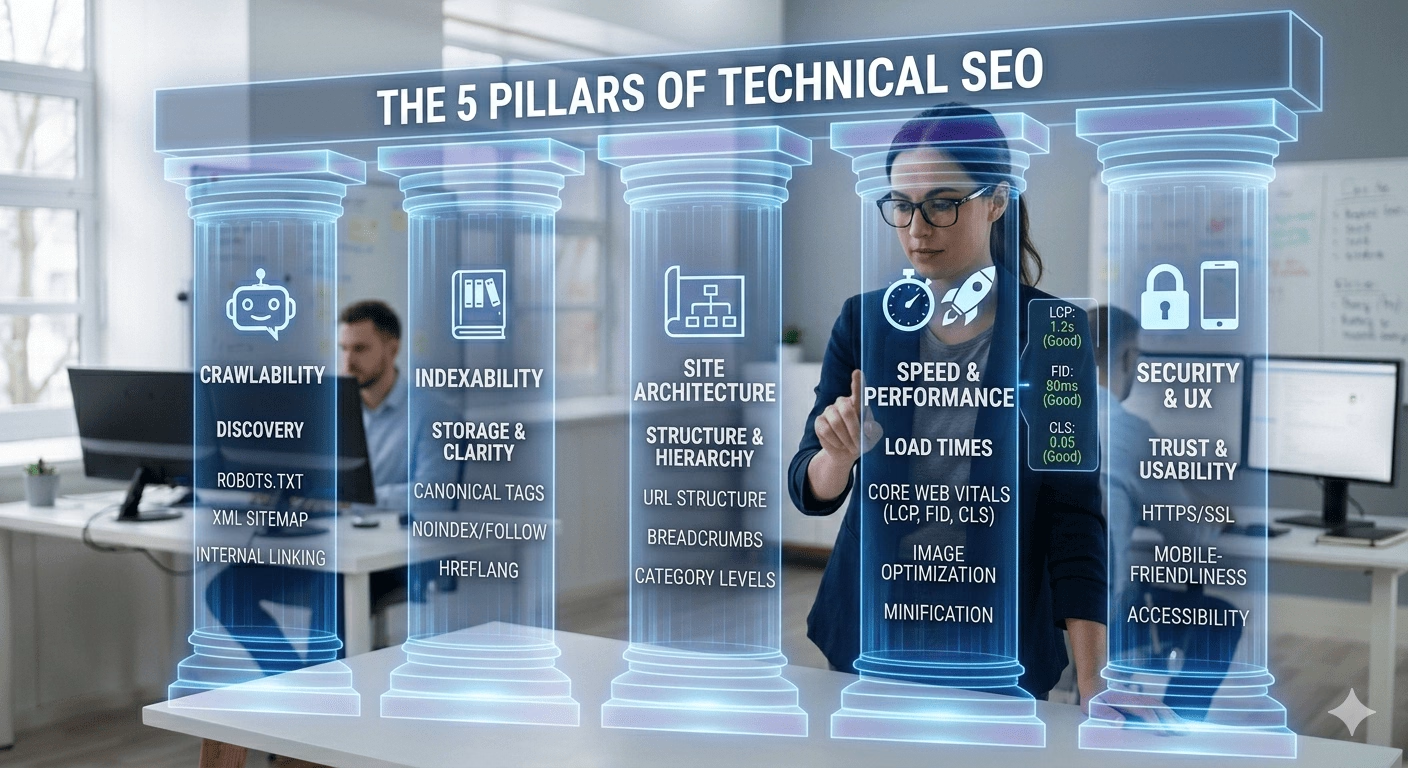
However, the fundamentals have not changed. Site speed, crawlability, proper indexing, mobile responsiveness, and Core Web Vitals remain essential prerequisites for visibility. As we noted in our guide on AI-First SEO for professional services, AI cannot reference what it cannot access. If your technical foundations are weak, no amount of content optimisation will compensate.
Link Building and Authority Signals
Backlinks still matter, but their relative importance has shifted. AI search systems evaluate authority through a broader lens that includes:
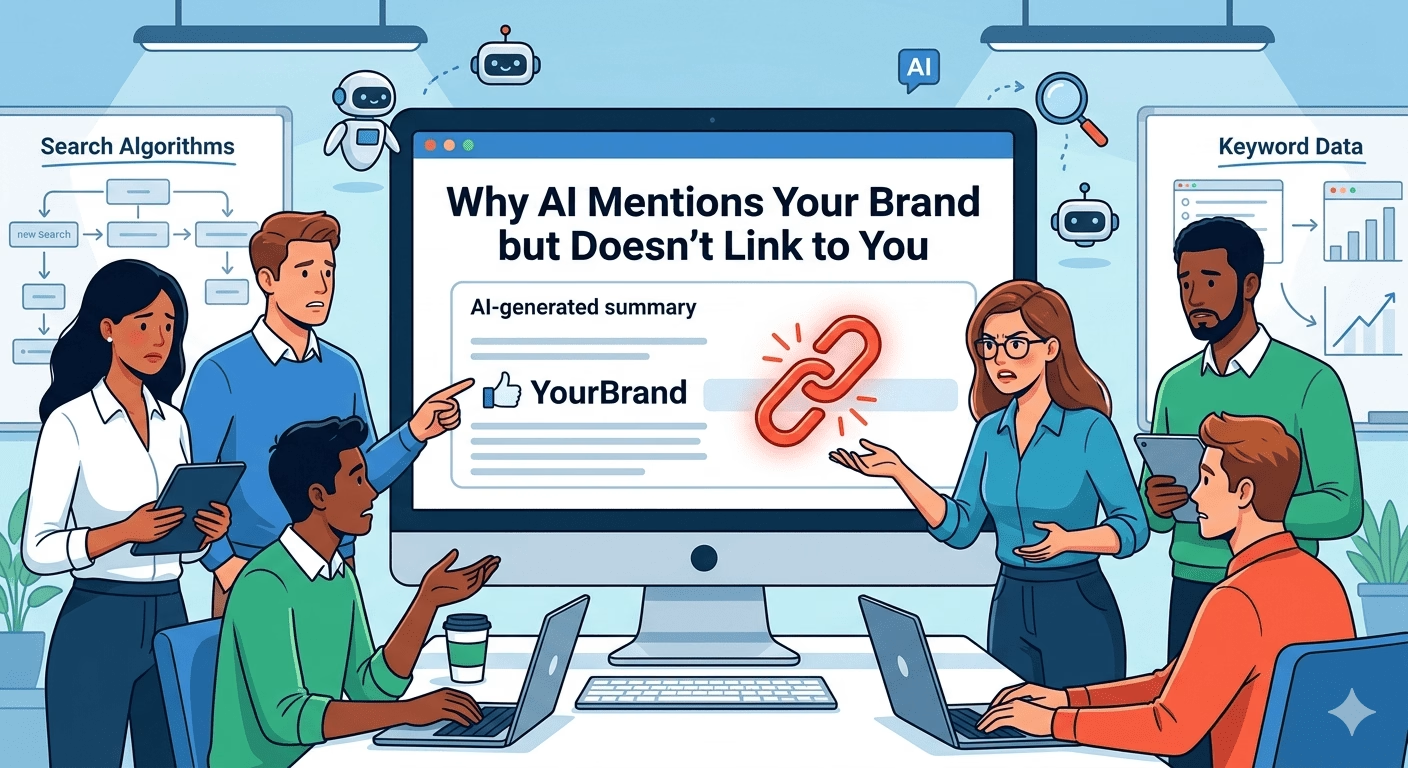
- Brand citations — unlinked mentions of your brand or experts across authoritative sources. As our article on brand citations explains, these mentions now function as trust signals for AI systems, much as backlinks have traditionally functioned for traditional search algorithms.
- Entity recognition — whether AI systems can identify your organisation as a known, trusted entity in your field.
- Cross-platform consistency — whether your brand information, expertise claims, and service descriptions are consistent across your website, social profiles, directories, and third-party mentions.
The most effective approach to authority building in 2026 combines traditional link acquisition with deliberate brand citation strategies and entity optimisation — a multi-channel approach to establishing the kind of digital footprint that AI systems trust.
The Rise of GEO as a Discipline
Perhaps the most significant conceptual development in the SEO industry over the past two years has been the emergence of Generative Engine Optimisation — GEO — as a distinct discipline.
What GEO Is and Why It Matters
GEO is the practice of optimising your digital presence to be cited, referenced, and recommended by AI-generated search experiences. Where traditional SEO focuses on ranking in a list of results, GEO focuses on being selected as a source by the AI that generates the answer.
The distinction matters because the criteria are different. An AI system generating a summary about, say, corporate restructuring law doesn’t simply look at which page ranks highest for that keyword. It evaluates which sources demonstrate the most authoritative, comprehensive, and clearly structured expertise on the topic — and then synthesises an answer from those sources.
For a thorough introduction to GEO principles and why they matter for every business with a digital presence, our article Beyond SEO: A Practical Introduction to Generative Engine Optimisation is essential reading.
The Relationship Between SEO and GEO
A common misconception is that GEO replaces SEO. It does not. The two disciplines are complementary, and success in one frequently supports success in the other.
Strong technical SEO ensures your content is crawlable and indexable — prerequisites for AI systems to access and evaluate it. Good content strategy, built around topical authority and clear entity definitions, serves both traditional ranking algorithms and AI citation selection. Structured data helps both Google’s ranking systems and its AI Overview generation.
The practical difference is in emphasis and measurement. GEO places greater weight on:
- Being cited in AI-generated answers rather than simply ranking on the SERP
- Brand visibility across multiple AI platforms, not just Google
- Entity clarity and structured data as foundational requirements
- Authority signals beyond backlinks — including brand citations, author expertise, and cross-platform consistency
For businesses ready to go deeper, our advanced GEO tactics guide covers the implementation details — from entity optimisation and citation acquisition to measuring AI visibility across platforms.
GEO Across Platforms
One of the most important aspects of GEO is that it extends beyond Google. Your business needs to be visible — and accurately represented — across the full ecosystem of AI-powered search tools that your audience uses.
This includes:
- Google AI Overviews — the most widely used AI search feature, appearing in a growing share of Google’s search results
- ChatGPT — increasingly used for research, recommendation, and comparison queries, particularly in B2B contexts
- Perplexity AI — favoured by researchers and analysts for its source-cited, depth-first approach to answering queries
- Google Gemini — embedded across Google’s product ecosystem and increasingly used as a default AI assistant
- Microsoft Copilot — integrated into Windows, Office, and Bing, reaching enterprise users in particular
Our guide on ranking in Perplexity, ChatGPT, and Gemini provides platform-specific strategies for each of these environments. The principle, however, is universal: you must optimise for the ecosystem, not just for a single search engine.
What This Means for Businesses Right Now
Theory and timelines are useful, but what matters to most business leaders is practical application. If you’re running a professional services firm, an e-commerce business, or any organisation that relies on search visibility for growth, here is what the AI transformation of search means for you today.
Your Website Is Still Your Foundation
Despite the rise of zero-click searches and AI-generated answers, your website remains the cornerstone of your digital strategy. AI systems need source material, and that material lives on websites. The firms being cited in AI Overviews, referenced in ChatGPT responses, and surfaced in Perplexity answers are — overwhelmingly — those with strong, well-structured, authoritative websites.
What has changed is the purpose of your website in the broader ecosystem. It is no longer solely a traffic destination. It is a knowledge base that AI systems draw upon to inform their answers. This means the quality, structure, and authority of your content matter more than ever — even if some of that content is consumed indirectly through AI-generated summaries rather than direct page visits.
Structured Data Is No Longer Optional
Schema markup — structured data that helps search engines and AI systems understand your content, your organisation, your authors, and your services — has moved from “nice to have” to essential infrastructure.
Without it, AI systems must infer what your content means. With it, you tell them explicitly. In a competitive landscape where AI is choosing which sources to cite, that explicitness provides a measurable advantage.
Our detailed guide on structured data for AI search walks through the implementation priorities for professional services firms, but the core schema types every business should have in place include Organisation, Person (for key authors and experts), Article, FAQ, and Service markup.
Brand Authority Is the New Link Equity
In the traditional SEO model, authority was primarily measured through backlinks. Links remain important, but AI systems evaluate authority more broadly. Brand mentions across the web — in industry publications, directories, news articles, podcast transcriptions, and forum discussions — all contribute to how AI perceives your organisation’s trustworthiness and expertise.
This is why brand citations have become such a critical component of modern search strategy. And it is why brand visibility in AI-powered search correlates strongly with consistent, widespread mentions across authoritative sources.
At Agile Digital Agency, we have seen this play out repeatedly in our client work. The firms that invest in thought leadership, PR, expert commentary, and consistent brand presence across their sector’s key platforms see measurably stronger AI visibility than those relying solely on on-site optimisation and link building.
You Need a GEO Strategy Alongside Your SEO Strategy
If your current digital marketing approach consists entirely of traditional SEO — keyword targeting, content publication, link building, and technical optimisation — you are missing a significant and growing portion of your potential audience.
GEO is not a replacement for SEO. It is an essential complement. A comprehensive digital visibility strategy in 2026 requires both: SEO to maintain and improve your presence in traditional organic results, and GEO to ensure your brand is cited, referenced, and recommended in AI-generated answers.
If you are unsure where your organisation stands, our GEO-ready website checklist provides a practical starting point for assessing your current position and identifying the highest-priority gaps.
Measurement Must Evolve
Traditional SEO metrics — organic traffic, keyword rankings, click-through rates — remain valuable but no longer tell the complete story. In an AI-driven search landscape, you also need to track:
- AI Overview citations — how frequently your content is referenced in Google’s AI-generated summaries
- Brand mention frequency — how often your brand appears across AI platforms when relevant queries are made
- Entity recognition — whether AI systems correctly identify and describe your organisation, services, and expertise
- Cross-platform visibility — your presence in ChatGPT, Perplexity, Gemini, and Copilot responses, not just Google
- Zero-click brand impressions — instances where your brand is visible to users even without a click-through to your website
The tools for tracking these newer metrics are still maturing, but forward-thinking agencies and in-house teams are already building dashboards that combine traditional analytics with AI visibility monitoring. The businesses that measure what matters now will be best positioned to respond to what changes next.
Key Takeaways
If you take away nothing else from this article, these are the points that matter most:
- AI has already reshaped search — this is not a future event. From Google’s AI Overviews to ChatGPT as a research tool, the transformation is well underway and accelerating.
- Traditional SEO is necessary but no longer sufficient. Keyword rankings and backlinks still matter, but they must sit within a broader strategy that includes entity optimisation, structured data, and brand authority.
- GEO is not optional. Generative Engine Optimisation — ensuring your brand is cited and recommended by AI systems — is now a core component of any serious digital visibility strategy.
- Structured data is foundational infrastructure. Schema markup helps AI systems understand your content, your expertise, and your organisation. Without it, you are leaving visibility on the table.
- Brand authority extends beyond links. Brand citations, thought leadership, cross-platform consistency, and entity recognition are now critical authority signals for AI search systems.
- Multi-platform visibility is essential. Your audience uses Google, ChatGPT, Perplexity, Gemini, and Copilot. Your strategy must account for all of them.
- AI tools enhance SEO workflows but do not replace expertise. The most effective approach combines AI-powered efficiency with human strategic judgement and subject-matter depth.
- Measurement must expand. Track AI citations, brand mentions, and entity recognition alongside traditional traffic and ranking metrics.
What Comes Next: The Road Ahead
Predicting the precise trajectory of AI in search is a fool’s errand — the pace of development over the past three years has proven that repeatedly. But based on the patterns we can observe, several developments appear highly likely.
AI Agents Will Change the Funnel
The next major shift is already underway: AI agents that don’t just answer questions but take actions on behalf of users. Google’s and OpenAI’s agent-based products can already browse the web, compare options, and execute tasks — from booking restaurants to sourcing professional services providers.
For businesses, this means the marketing funnel itself is being compressed. A user who asks an AI agent to “find a law firm specialising in commercial property in London” may receive a recommendation, a comparison, and a contact prompt — all within a single interaction, without ever visiting a search results page. Being the brand that AI agents recommend will become as important as being the brand that ranks on page one.
Personalisation Will Intensify
AI search is moving rapidly towards personalised results — answers tailored to the individual user’s context, history, location, and preferences. This has significant implications for SEO and GEO strategies, as the same query may yield different AI-generated answers for different users.
The businesses best positioned for this shift are those with strong entity profiles and diverse, authoritative content — because personalisation algorithms will favour sources they can confidently match to specific user contexts.
Content Quality Standards Will Rise
The flood of AI-generated content has already prompted Google and other platforms to raise the bar for what qualifies as helpful, original, and authoritative content. This trend will continue. Generic, undifferentiated content — regardless of whether it was written by a human or generated by AI — will struggle to earn visibility in an environment where AI systems have more content to choose from and increasingly sophisticated quality filters to apply.
The premium will be on genuine expertise, original insights, proprietary data, and perspectives that AI cannot easily replicate from existing web content. Thought leadership will not be a nice-to-have; it will be a competitive requirement.
The SEO and GEO Convergence
Over time, the distinction between SEO and GEO will likely blur. As AI becomes integral to all search experiences — not just a feature layered on top — the principles of GEO will simply become part of what good SEO means. Entity optimisation, structured data, brand authority, and cross-platform visibility will be standard components of any search strategy, not specialist additions.
At Agile Digital Agency, we’ve been navigating this convergence with our clients since the earliest days of SGE. The firms that have treated AI search as a strategic priority — rather than waiting for the landscape to settle — are the ones seeing the strongest returns today. That pattern will only intensify as AI becomes more deeply embedded in how people discover, evaluate, and choose the businesses they work with.
The Imperative to Act
If there is one lesson from the past three years, it is that waiting for clarity is not a viable strategy. The businesses that adapted early — investing in entity optimisation, structured data, and AI-aware content strategies while competitors were still debating whether AI search would matter — secured advantages that will be increasingly difficult to replicate.
The window for being an early adopter has closed. But the window for being a fast follower remains open. The question for every business leader is simple: is your digital strategy built for the search landscape that exists today, or the one that existed three years ago?
If you’re ready to close that gap, Agile Digital Agency can help. Explore our SEO services to see how we integrate traditional SEO with AI-era strategies, or get in touch to discuss where your business stands and what the right next steps look like.
Frequently Asked Questions
How has AI changed SEO since 2023?
AI has fundamentally restructured search by introducing AI-generated answers (such as Google’s AI Overviews) directly into search results, creating new AI-native search platforms like Perplexity and ChatGPT, shifting authority signals from purely backlinks to include brand citations and entity recognition, and requiring businesses to optimise for multiple AI-powered platforms simultaneously rather than Google alone.
What is the difference between SEO and GEO?
SEO (Search Engine Optimisation) focuses on ranking your web pages in traditional search results. GEO (Generative Engine Optimisation) focuses on ensuring your brand and content are cited, referenced, and recommended within AI-generated answers. The two disciplines are complementary — strong SEO supports GEO, and both are necessary for comprehensive digital visibility in 2026.
Are Google AI Overviews replacing organic search results?
AI Overviews are not replacing organic results, but they are appearing above them for a growing proportion of queries — particularly informational ones. This means that being cited within the AI Overview is becoming as important as ranking in the traditional organic listings below it. Businesses need strategies that address both positions.
Do traditional SEO techniques still work in 2026?
Core SEO techniques — technical optimisation, quality content creation, keyword research, and link building — remain essential. However, they must now operate within a broader strategy that includes structured data implementation, entity optimisation, brand citation building, and cross-platform AI visibility. Traditional SEO alone is no longer sufficient for maintaining competitive visibility.
How can businesses measure their visibility in AI search?
Beyond traditional metrics like rankings and organic traffic, businesses should track AI Overview citation frequency, brand mention presence across AI platforms (ChatGPT, Perplexity, Gemini), entity recognition accuracy, and zero-click brand impressions. Specialist monitoring tools are emerging, and proactive businesses are building dashboards that combine traditional analytics with AI visibility tracking.
What is structured data and why does it matter for AI search?
Structured data (schema markup) is code added to your website that helps search engines and AI systems understand your content, organisation, authors, and services in a machine-readable format. It matters because AI systems use structured data to identify authoritative sources, correctly attribute expertise, and select content for citation in generated answers. Without it, AI must infer meaning from unstructured text, placing you at a disadvantage.
Should businesses optimise for AI platforms beyond Google?
Yes. In 2026, a significant and growing proportion of research and discovery happens through AI platforms including ChatGPT, Perplexity AI, Google Gemini, and Microsoft Copilot. Each platform has its own approach to sourcing and citing information. A comprehensive visibility strategy must account for the full ecosystem of AI-powered search tools your target audience uses, not just Google.

Related
Articles
![What Is Entity-Driven SEO? A Practical Guide for Professional Services [2026]](https://www.agiledigitalagency.com/wp-content/uploads/2026/03/What-Is-Entity-Driven-SEO-1.avif)