Digital Marketing BlogMaster AI SEO: Rank Higher in Perplexity, ChatGPT, and Gemini
 Master AI SEO: Rank Higher in Perplexity, ChatGPT, and Gemini
AI Search is Changing the Game-Is Your Business Ready?
AI-powered search engines like Perplexity, ChatGPT, and Gemini are reshaping online visibility. Unlike Google, they don’t just rank websites, they curate trusted sources. If your business isn’t optimised for AI search, you could be invisible in the next wave of digital discovery.
Download our guide: How AI Search Engines Choose Their Sources
If you haven’t yet read our Ultimate Guide to AI-First SEO for Professional Services, start there.
Now, let’s break down how these search engines work and, more importantly, what you can do to ensure your business stands out in AI SEO and Generative Engine Optimisation (GEO).
In this article:
AI SEO in 2026
- Perplexity favours trusted, up-to-date, multi-format content (text + video) and often cites academic or niche sources.
- ChatGPT (GPT-5) now uses “rerank” configuration flags, meaning optimisation can target explicit ranking factors. Answer Engine Optimisation (AEO) and Generative Engine Optimisation (GEO) are essential.
- Gemini combines traditional SEO with strict fact-checking. Schema, structured data, and well-cited claims are critical.
- Cross-engine best practices:
- Authoritative, expert-driven content
- Structured formatting with schema and FAQs
- Freshness and regular updates
- Multi-format content (articles, video, infographics)
- Brand mentions and authority signals
Bottom line: In 2026, ranking in AI search isn’t just about keywords, it’s about becoming a trusted source cited inside AI answers.
How AI Search Engines Select Their Sources
| AI Engine | Core Signals | Advanced Signals |
|---|---|---|
| Perplexity AI |
• Trustworthiness – Reputable domains • Recency – Fresh updates • Relevance – NLP intent matching • Authority – Niche expertise • Multi-format content – Text + video |
• Structured content (headings, bullets) • Direct question answers • Contextual depth • Multiple source citations |
| ChatGPT |
• Relevance to query • Credibility – Academic/gov sources • Freshness of information • User engagement & popularity • Content quality |
• Rerank configuration flags • Fact-checked content • Source diversity • Semantic matching |
| Gemini |
• Relevance – Semantic understanding • Authority & trustworthiness • Content quality • User experience (UX) |
• Data source quality • Contextual understanding • Fact-checking verification • Prompt sensitivity |
Perplexity AI
Perplexity doesn’t index the entire web like Google. Instead, it carefully selects sources that meet its high standards for trustworthiness, recency, and relevance. Beyond these visible factors, Perplexity also applies AI-driven ranking mechanisms that can dramatically affect which pages are surfaced.
Core Signals
- Trustworthiness – Favours reputable, curated domains rather than a vast index.
- Recency – Prioritises fresh updates, especially for fast-moving topics.
- Relevance – Uses NLP to understand intent and context behind queries.
- Authority – Rewards niche expertise and consistency in publishing.
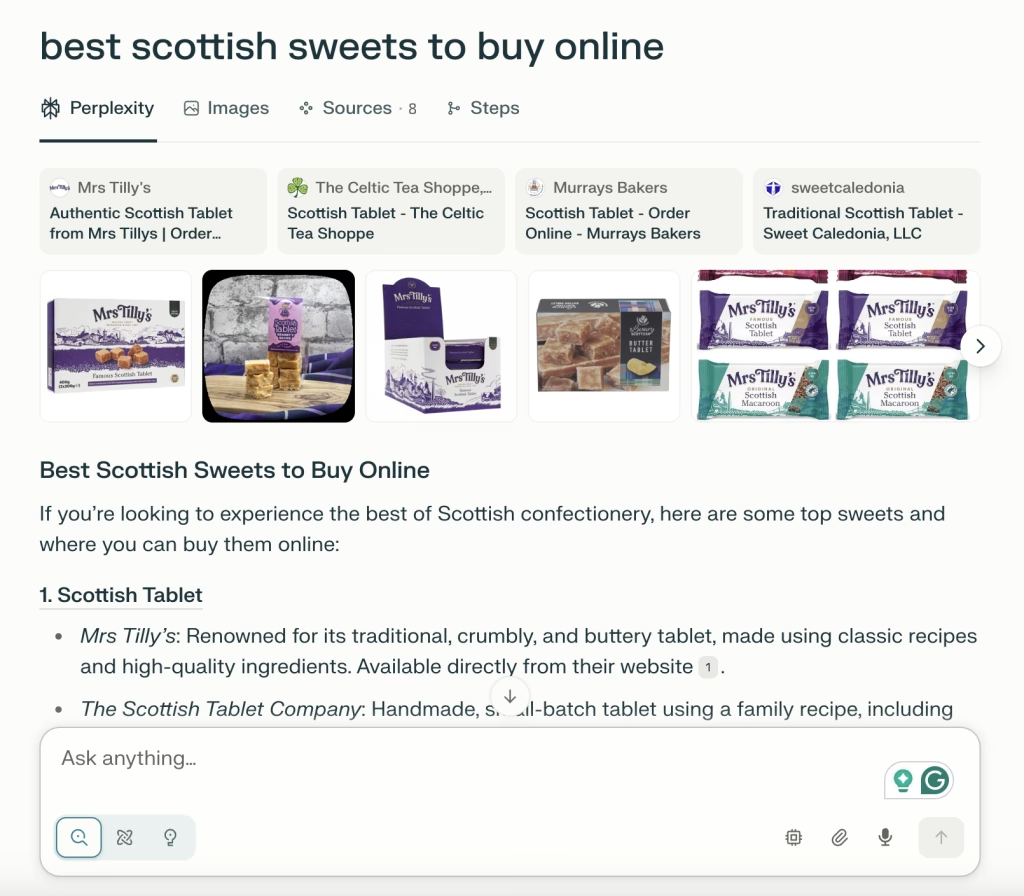
- Multi-format content – Prefers articles with embedded videos (especially YouTube).
- Academic & specialised sources – For Pro Search queries, often surfaces peer-reviewed or industry resources.
- Real-time web sourcing – Pulls live data for time-sensitive queries.
- User-centric approach – Focuses on refining results through specific question answering, not sponsored links.
Advanced Signals
- Structured content with clear headings, bullet points, schema.
- Direct, concise answers to questions.
- Contextual depth (not just surface coverage).
- Citing multiple trusted sources.
- User engagement proxies (shares, references, mentions).
2026 Insight: Perplexity is doubling down on multi-format content. Shorter articles paired with embedded videos consistently gain more visibility.
ChatGPT
When performing a web search, ChatGPT (GPT-5) ranks results using both traditional trust signals and new AI-driven factors.
Core Signals
- Relevance to the query – Based on intent and semantic matching, not just keywords.
- Credibility of the source – Prioritises academic, government, and established publishers.
- Freshness of information – Favours up-to-date content.
- User engagement & popularity – Widely cited and referenced sites are elevated.
- Content quality – Fact-checked, well-written, and in-depth articles win.
- Lack of bias & misinformation – Avoids unreliable or extreme sources.
- Diversity of sources – Surfaces multiple perspectives, not single voices.
2026 Update: How GPT-5 Really Ranks Results
Recent analysis (via Metehan.ai) revealed that ChatGPT-5’s search configuration includes “rerank” flags, which are visible in developer tools.
This means:
- Ranking is partly controlled by explicit configuration parameters.
- Trust, recency, and authority are weighted in a transparent and tunable manner.
- Optimisation can align more closely with how GPT-5 is technically configured.
This is the clearest evidence yet that AI search ranking isn’t just a black box, it’s partly rule-driven.
Where GEO and AEO Fit In
- AEO (Answer Engine Optimisation): Make your content extractable as concise answers.
- GEO (Generative Engine Optimisation): Ensure your content gets cited inside AI-generated answers.
Together, these strategies move you beyond “being found” to “being referenced.”
Looking Ahead: G-SEO
New research into Role-Augmented Intent-Driven G-SEO suggests tailoring content for multiple intent roles so it surfaces across more AI-driven contexts. While still emerging, it’s the next step for businesses serious about AI visibility.
Gemini
Gemini combines traditional Google-style ranking with advanced AI reasoning. It’s not just about relevance, it’s about trust and usefulness.
Traditional Signals
- Relevance to the query – Semantic understanding beyond keyword matching.
- Authority & trustworthiness – Reputation, backlinks, and author expertise.
- Content quality – Full, original, and well-written.
- User experience (UX) – Mobile-friendly, fast, and easy to navigate.
AI-Specific Signals
- Data Source Quality – Pages that align with Gemini’s high-quality training data are prioritised.
- Contextual Understanding – Goes beyond keywords to match nuanced queries.
- Summarisation & synthesis – Prefers content that contributes clear, verifiable facts to summarised answers.
- Fact-checking & verification – Cross-references claims against multiple trusted sources.
- Prompt sensitivity – Pages must address how users phrase questions, not just the topic itself.
2026 Insight: Gemini’s fact-checking is stricter than Google Search. If your page makes a claim, it should be backed by citations that Gemini can verify.
Per-engine bias: what each AI engine actually weights
The biggest miss in most “AI SEO” advice is treating the engines as interchangeable. They are not. HubSpot’s analysis of millions of AI prompts surfaced a tactical pattern worth naming explicitly: each engine has a distinct prioritisation bias, and optimising blindly for one will under-perform on the others. Here is the matrix we now use to plan content per engine:
| Engine | What it weights most | What to do about it |
|---|---|---|
| ChatGPT | Credible, authoritative sources with transparent identity signals; self-citation of other credible sources builds trust. | Explicit author bios, named expertise, sourced claims with outbound links to authoritative third parties. |
| Google Gemini | Content already ranking in the top 20 organic results is prioritised; clear headers and structured schema for extraction. | Traditional SEO is not optional for Gemini visibility – earn the organic rank first, then optimise the on-page structure for clean extraction. |
| Perplexity | Data-backed, well-researched content with statistics, inline citations to credible sources, and multiple integrated perspectives. | Embed statistics with sources, contrast viewpoints honestly, link out to the studies and reports you reference. |
| Microsoft Copilot | Commercial and transactional intent – explicit product descriptions, features, pricing, and strong brand identity. | Be specific about what you sell, what it costs, who it is for. Vague positioning under-performs hardest here. |
Source: HubSpot, “7 AEO Secrets I Discovered from Millions of AI Prompts,” GROW ANZ 2026. The single most important takeaway: Gemini’s reliance on organic rank means classic SEO is the prerequisite, not the alternative, to AI search visibility – which is one reason we don’t treat SEO and GEO as separate disciplines.
How Can Your Business Get Featured in AI Search Results?
As AI SEO optimisation becomes increasingly important for visibility on platforms such as Perplexity, ChatGPT and Gemini, businesses must adapt their strategies to align with AI‑driven ranking factors.
These factors prioritise content quality, trustworthiness, contextual relevance and multi‑format content over traditional SEO metrics. Measurement now extends beyond conventional keyword tracking to include monitoring mentions in AI‑generated answers, involving the analysis of LLM content and prompts with tools such as SE Ranking, which should integrate standard SEO functions with specialised AI search tracking.
Here’s how your business can optimise for AI-driven search results:
1. Establish Unquestionable Authority in Your Niche
- Publish Expert-Driven Content: AI favours businesses that demonstrate clear expertise in their industry. Regularly publish high-quality, niche-specific content with insights from qualified professionals.
- Cite Reliable Sources: Reference authoritative data sources to enhance credibility.
- Use Thought Leadership: Engage in guest posts, webinars, and collaborations with industry experts.
- Invest in Ethical Link Building: Secure backlinks from reputable sources while avoiding black-hat SEO tactics.
- Work on Domain Authority & Author Expertise: Build a strong online reputation through trusted backlinks and recognised authorship.
Read also: Building Trust Online: Key Strategies for Professional Service Providers
2. Prioritise Full, AI-Friendly Content

- Optimise for Answer-Based Queries: AI search engines prioritise content that provides direct, concise, and clear answers to user questions.
- Structure Content for AI Readability: Use headings, bullet points, and structured formatting to improve AI comprehension.
- Incorporate Multi-Format Content: AI search engines, including Gemini and Perplexity, favour articles with embedded YouTube videos via oEmbed (perfect for WordPress carousels), infographics, and images. In our own testing across professional-services queries, shorter articles (800–1,500 words) paired with at least one embedded video tend to be cited more often than long-form text-only pieces – though this varies meaningfully by engine and topic.
- Maintain a Regular Content Update Cycle: AI prioritises fresh content, so update your website frequently, especially if your business covers news, technology, or events.
- Prioritise Quality Over Quantity: High-quality, well-researched content will always outperform keyword-stuffed or low-value articles.
Read also our Free AI SEO Tools guide.
3. Implement Technical SEO and AI-Specific Optimisation

- Use Schema Markup: Structured data helps AI better understand and rank your content.
- Improve Site Speed & Mobile Optimisation: A fast, mobile-friendly, and easy-to-navigate website is important for AI search rankings and user experience.
- Optimise for Featured Snippets & AI Summaries: Target clear, structured answers with key takeaways that AI can extract easily.
- Ensure Content is Fact-Checked & Verified: AI models penalise misinformation, so verify all facts before publishing.
Read also: Technical SEO Optimisation: A Complete Guide for Small Businesses
4. Engage in Proactive AI Search Marketing

- Develop AI-Optimised PR Strategies: AI-driven search engines consider press releases and media coverage, get featured in high-authority publications.
- Encourage Brand Mentions in Trusted Sources: Even without direct links, brand mentions in reputable publications signal authority.
- Create and Distribute AI-Optimised PR: Ensure your press releases and media content are structured for AI search engines.
- Monitor & Adapt to AI Algorithm Changes: Stay updated on AI search trends and adjust your strategy accordingly.
Read also: AI Marketing Tools: 8 Strategies for Professional Services Businesses
5. Enhance User Experience & Engagement Metrics

- Create a Seamless User Journey: A well-structured, easy-to-navigate website with clear CTAs improves engagement and reduces bounce rates.
- Boost On-Page Engagement: AI recognises time spent on pages, interaction rates, and engagement signals, make content interactive and valuable.
- Avoid Clickbait & Misleading Content: AI search engines evaluate content authenticity, misleading titles or low-quality content can negatively impact visibility.
Read also: How User Experience Affects SEO
6. Monitor AI Search Visibility
Measuring AI-search visibility is harder than measuring classic SEO because there is no consolidated “AI Search Console” yet – you have to triangulate. Here is the per-engine framework we use with clients, and how to bake it into a repeatable monthly cadence.
Per-engine presence tracking
Build a tracked query list of 20–50 of your highest-intent terms (commercial and informational) and run them on each surface every two weeks. Log: were you cited / mentioned / linked / not present, and the rough position of your citation in the response.
- ChatGPT (with Search): log whether you appear in the cited-sources list and where in the answer your name surfaces.
- Perplexity: log citation count and citation position – Perplexity exposes its sources explicitly, which makes this the easiest engine to track manually.
- Google AI Overviews: check both directly and via Ahrefs / Semrush SERP tracking tools that flag AI Overview presence per keyword.
- Gemini: query via Gemini and Google AI Mode; log citations and whether your page is linked.
- Bing Copilot: still surfaces a meaningful share of B2B citations, particularly for enterprise queries – don’t skip it.
Tooling that does the heavy lifting
- Ahrefs Brand Radar and Semrush AI Toolkit track brand mentions and share-of-voice across major AI engines and report it as a time series.
- Profound, Otterly, AthenaHQ and similar GEO-specific platforms run scheduled prompts against multiple AI engines and report your mention rate.
- Server logs reveal traffic from
GPTBot,ClaudeBot,PerplexityBot,OAI-SearchBotandGoogle-Extended– a leading indicator that AI engines are actively reading your content.
Isolating AI-referral traffic in GA4
To see what AI is actually sending you, create a GA4 segment that filters Sessions where the referrer matches chat.openai.com, perplexity.ai, gemini.google.com, copilot.microsoft.com, or you.com. Compare the trend monthly against classic organic. Combine with engagement metrics (engaged sessions, average engagement time, key events) to judge whether AI-referred visitors actually convert – in our client data, AI-referred sessions are typically lower-volume but materially higher-intent than generic search.
Monthly cadence we recommend
- Week 1: run the tracked query list across all five surfaces, log presence + position.
- Week 2: pull the AI-referral GA4 segment and crawler-log traffic; flag any sudden drops.
- Week 3: refresh the two or three pages that fell out of citations or that AI Overviews now answers without linking to you.
- Week 4: review trend lines for share-of-voice and citation count; adjust the editorial calendar for the next month based on which topics are over- and under-represented in AI answers.
The Bottom Line
AI search engines are transforming how businesses gain online visibility. If you’re still relying solely on traditional SEO strategies, you’re already behind.
By focusing on authority, high-quality content, and AI SEO strategies, your business can stay ahead in the AI-driven search revolution.
📊 How do you know any of this is working? We have written a separate guide on how to measure GEO and AI-SEO success – covering per-engine presence tracking, GA4 referral isolation for AI sources, server-log signals from AI crawlers, share-of-voice calculation, and the monthly cadence we run for clients.
Frequently Asked Questions
How does Perplexity choose sources in 2026?
Perplexity prioritizes trustworthiness, recency, niche authority, and multi-format content (text + YouTube videos). Structured data and clear headings boost visibility.
What is ChatGPT’s rerank system?
ChatGPT-5 uses explicit rerank flags weighting trust, freshness, and semantic relevance. GEO aligns content with these tunable parameters.
Can WordPress sites rank in AI search?
Yes, fast WordPress sites with schema markup, embedded videos, and expert content excel in Perplexity, ChatGPT, and Gemini results.
Want to Dominate AI-Driven Search Results?
The future of search is here, are you ready to adapt and stay ahead? Start implementing these strategies today and position your business as a trusted source inside AI itself.
At Agile, we specialise in helping businesses like yours navigate the evolving AI search landscape with data-driven strategies that deliver real results. Let’s future-proof your digital presence, get in touch today for a FREE consultation!

Related
Articles