 Digital Marketing Blog28 Link Building Mistakes to Avoid in Your SEO Strategy [2026]
 28 Link Building Mistakes to Avoid in Your SEO Strategy [2026]
Effective link building remains one of the most powerful ways to boost your website’s ranking on SERPs — but in 2026, the rules have changed significantly.
High-quality links still increase your chances of ranking higher and reaching your target audience. But now, they also feed directly into how AI search engines evaluate your brand’s authority and trustworthiness.
The process of link building is not always straightforward, and many businesses make mistakes that can harm their website’s ranking — or worse, trigger penalties from Google’s increasingly sophisticated spam detection systems.
To ensure that your link-building efforts are effective and successful in the age of AI search, it is essential to avoid the common link-building mistakes listed in this guide.
Key Takeaways
- Link quality now outweighs link quantity more than ever — Google’s SpamBrain and AI-driven algorithms are significantly better at detecting manipulative link patterns in 2026.
- E-E-A-T signals from your backlinks matter — links from authoritative, topically relevant sources strengthen your Experience, Expertise, Authoritativeness, and Trustworthiness profile.
- Brand citations are now as important as traditional backlinks — AI search engines (Google AI Overviews, ChatGPT, Perplexity) use unlinked brand mentions to assess authority.
- AI-generated link spam is being caught faster — automated, templated outreach and AI-spun guest posts are detected and devalued almost instantly.
- Link quality signals feed into GEO visibility — your backlink profile directly influences whether AI systems cite and recommend your brand in generative search results.
- Focus on earning links naturally — through genuinely valuable content, digital PR, thought leadership, and strategic relationship building.
In this article:
1. Buying Links
Buying links is when you pay another site to place a link to your website. This directly violates Google’s spam policies and can result in severe penalties, including manual actions and exclusion from search results.
In 2026, Google’s SpamBrain algorithm is significantly more advanced at detecting paid link patterns — including those disguised as editorial placements, sponsored content without proper disclosure, and bulk link purchases from link brokers. The system can now identify transactional link patterns at scale, even when sellers attempt to make them appear natural.
Be wary of low-cost offers for links, as they often come with the risk of being associated with irrelevant and potentially harmful sites. Remember, a legitimate link-building strategy takes time and effort to cultivate high-quality links that genuinely strengthen your brand authority.
2. Posting on Private Blog Networks
Google has been actively working to identify and eliminate Private Blog Networks (PBNs) for years — and in 2026, SpamBrain’s ability to detect PBN footprints is more sophisticated than ever.
PBNs are networks of websites created solely to build links to a target site. They typically share hosting patterns, similar templates, thin content, and unnatural interlinking structures. Google’s AI-driven spam systems can now identify these networks even when operators take steps to disguise them.
The risk-to-reward ratio of PBNs has never been worse. Detection can lead to complete deindexing of both the PBN sites and the sites they link to. It is essential to stay away from such practices and focus on ethical, sustainable link-building strategies that build genuine E-E-A-T signals.
3. Abusing Reciprocal Link Building
A study by Ahrefs found that almost half of the 112,440 top-ranking pages have some reciprocal links.
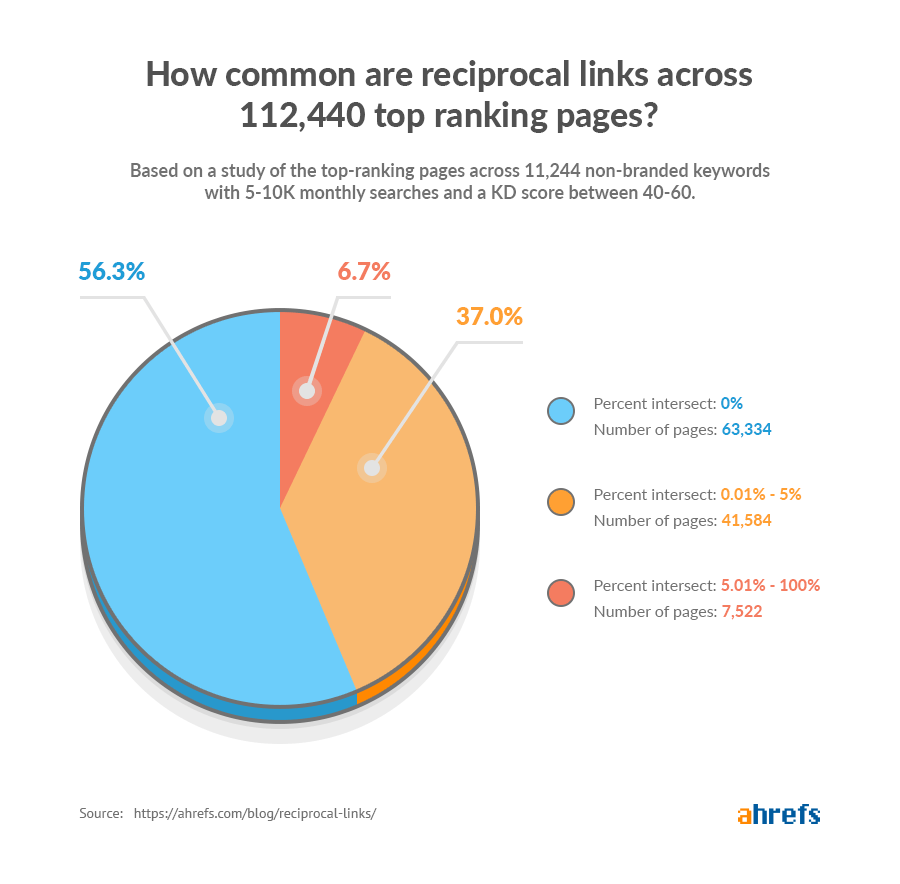
Reciprocal link building can be a beneficial practice when done naturally and organically. It is common for websites to reference one another within their niche and receive links in return, which can help improve search engine rankings.
However, if reciprocal link building becomes excessive or manipulative, it can harm your website’s credibility and search engine ranking.
Abusing reciprocal link building by contacting numerous sites and asking for excessive link exchanges — particularly on non-relevant or standalone link pages — can result in negative consequences for your website. Google’s algorithms are increasingly adept at identifying link exchange schemes that exist purely for SEO manipulation rather than genuine editorial value.
Maintain a balanced and natural approach to reciprocal link building to reap its benefits without triggering spam filters.
4. Not Removing Bad Links
Maintaining a clean and robust link profile (the total of all links pointing to your site) is an important aspect of effective link building.
Failing to remove bad links can harm your website’s search engine ranking, credibility, and — increasingly — your visibility in AI search results.
It is important to regularly monitor your link profile and identify any broken links, link farms, or spammy websites. Once you have identified problematic links, take steps to have them removed. If the website owner is unresponsive, you can use Google’s Disavow Tool to signal to Google that you do not want these links to be considered part of your link profile.
In 2026, toxic backlinks do not just affect your traditional rankings — they can also undermine the E-E-A-T signals that AI search systems use to determine whether to cite or recommend your brand. A polluted backlink profile tells both Google and AI engines that your site may not be a trustworthy source.
5. Creating Links Solely for Link-Building
The purpose of link building is not solely to gather links, but also to generate traffic and enhance the credibility and authority of your website.
Obtaining links solely to increase your link count from subpar, unrelated sources is a typical mistake that can harm your website’s reputation. This is especially true in 2026, where AI search engines assess the contextual relevance of your entire link profile when deciding whether to reference your brand.
Instead, prioritise building links from reputable, high-traffic sources that can drive meaningful traffic, enhance credibility, and strengthen the authority signals that both traditional and generative search engines rely on.
6. Submitting to Too Many Directories
Submitting your website to too many low-quality directories is one of the most common link-building mistakes, and it can do more harm than good for your link-building efforts.
Search engines are more than capable of detecting and penalising such practices.
Instead, focus on submitting to only a few high-quality directories that can bring actual traffic to your site. Look for niche-specific directories that are selective with their listings, or well-known directories with genuine editorial standards.
That said, high-quality directory listings still serve a valuable purpose in 2026 — they contribute to your brand’s citation profile, which AI search engines use to verify your entity’s legitimacy and authority. The key is selectivity over volume.
Bulk directory submission, as an effective and scalable link-building tactic, is a thing of the past.
7. Not Checking Your Links Regularly
Neglecting to regularly monitor your links is a common and easily preventable mistake in link building.
Ensure that your links are active and functioning properly by conducting frequent checks. If a link is no longer working, reach out to the site owner to resolve the issue. By doing so, you can avoid the negative impact of broken links on your website.
Maintaining the health of internal links on your website is also very important, as a broken internal link can halt a search engine crawler’s progress, limiting its ability to access other pages linked from that page. For a thorough guide on keeping your site’s technical foundation solid, see our guide on technical SEO optimisation.
8. Creating Links That Are Not Editorially Placed
Creating links that are not editorially placed is a common link-building mistake. In other words, the link is not placed within genuine article content, but rather in a forum signature, comment section, or user-generated profile.
Many websites allow users to leave comments, and you might consider adding a comment with a link to your website. It seems like a free link, doesn’t it?
Generally, these are nofollow links, so they may generate some traffic, but they will not improve your SEO.
Commenting on a select number of authority sites in your niche can very much be part of a white-hat strategy, but the comments should be manual and relevant.
Abusing this may result in spam reports to Google, and Google may take manual action against you. In 2026, SpamBrain is particularly effective at identifying patterns of non-editorial link placement at scale — so even if individual instances seem harmless, doing it systematically will raise red flags.
The bottom line: apply common sense. If your non-editorially placed link has a valid purpose, you are likely to be fine in Google’s eyes.
Read also: What are backlinks from social bookmarking sites?
9. Creating Links from Websites That Are Not Indexed by Google
Google only considers links from indexed websites when determining the relevance and authority of a site. If a website is not indexed, its links will not be seen or considered by the search engine.
Additionally, links from non-indexed sites may even harm your website’s reputation, as they may be seen as low-quality or spammy links.
To ensure that your link-building efforts are effective, it is important to focus on acquiring links from high-quality, authoritative, and indexed websites. Before pursuing a link opportunity, verify that the site is actually in Google’s index — a simple site: search will confirm this quickly.
10. Creating Links from Websites in a Different Language
If your site is in the UK, Google would generally expect to see a good percentage of your links coming from other UK sites. Certainly, the bulk of your links should be from sites that are written in English.
A high percentage of low-quality foreign language sites (look for .cn and .ru in particular) linking to you is a big red flag.
Of course, if the foreign language site linking to you is high quality and topically relevant, then that should probably be fine. The key signal Google (and AI search systems) look for is whether the language and geographic profile of your backlinks makes sense for your business and audience.
11. Not Optimising Anchor Text
Anchor text refers to the clickable text that displays a link to another page or document.
Optimising it is essential for successful link building, but some people overlook this key aspect, leading to inadequate results.
Well-crafted anchor text helps search engines understand the context and relevance of the linked page. Generic anchors like “click here” or “read more” waste an opportunity to provide topical signals. Aim for anchor text that is descriptive, natural-sounding, and relevant to the destination content.
12. Over-Optimised Anchor Text
Anchor text optimisation is a key aspect of link building, but it is easy to overdo. Over-optimising anchor text can occur due to the urge to keyword-stuff or a lack of variety in anchor text.
This can trigger penalties from search engines as it appears spammy.
Google’s SpamBrain is now extremely effective at detecting unnatural anchor text distributions. If a disproportionate number of your backlinks use exact-match keyword anchors, it signals manipulation rather than genuine editorial endorsement.
The aim should be to create anchor text that sounds natural and accurately reflects the content of your page, not just to stuff keywords in. Remember, quality over quantity is key in link building.
13. Using the Same Anchor Text Repeatedly
Repeated usage of the same anchor text is a common link-building mistake.
Doing so can negatively impact your SEO as it can be seen as spammy by search engines. The issue arises when all of your backlinks have matching anchor text with the target keyword on the target page. This raises suspicions with Google and may result in penalties.
To avoid this, ensure your anchor text is relevant to the page you are linking to, and vary your keywords and phrases to describe your content. A natural backlink profile includes a healthy mix of branded anchors, partial-match keywords, generic terms, and naked URLs.
14. Neglecting the Link’s Title
Neglecting the title attribute of a link during link building is a common mistake.
The title, shown when hovering over a link, conveys additional information to both users and search engines about the linked page’s content.
Failing to provide a descriptive and relevant title may reduce the contextual signals available to search engines. Ensure link titles accurately reflect the linked page’s topic, for example, “dog food” for a page about dog food, not a generic “click here.”
15. Creating Links with the Wrong Anchor Text
Search engines use anchor text to determine the relevance and context of the linked page, so if the anchor text is misleading or irrelevant, it can lower the credibility and ranking of both the linking and linked pages.
In addition, it gives users a poor experience if they click on a link expecting one type of content but receive something completely different.
Therefore, it is important to choose anchor text carefully and ensure it accurately represents the linked content. This is even more critical in the AI search era, where contextual relevance signals are weighed heavily by generative engines deciding which sources to cite.
16. Guest Posting on Irrelevant Websites
Guest posting on reputable sites within your industry, with mainly branded anchor links, can be beneficial for your link building. However, if your focus is solely on quantity and exact-match anchor text, it can result in penalties from search engines.
In 2026, this mistake has evolved. Many businesses now use AI to mass-produce guest post content for irrelevant sites. Google’s AI-driven spam detection is highly effective at identifying these patterns — templated outreach, generic AI-written content placed on unrelated blogs, and transactional guest posting schemes are flagged quickly.
The most effective guest posting strategy focuses on genuine thought leadership on relevant, authoritative platforms where your expertise adds real value to their audience. This approach not only builds links but strengthens the E-E-A-T signals that AI search engines rely on.
17. Not Measuring Results
A common error in link building is failing to track results. Simply building links does not guarantee increased traffic or conversions.
To maximise the success of your link-building efforts, it is crucial to monitor progress and evaluate results. This allows you to make adjustments to your strategy and maximise the benefits of your efforts.
In 2026, measurement should go beyond traditional metrics like domain authority and referral traffic. You should also track:
- Whether your brand is being cited in AI-generated search results
- Brand mention frequency across the web
- E-E-A-T improvements tied to link acquisition
- Visibility in Google AI Overviews and other generative engine results
18. Not Leveraging Relationships
If you are not leveraging relationships, you are missing out on a key opportunity for obtaining high-quality links.
Building connections with other industry webmasters, relevant companies, and brands expands your content reach and increases the likelihood of getting more links and exposure for your business.
In the AI search era, relationship-driven link building is more valuable than ever. Genuine partnerships lead to natural brand citations and editorial mentions — the exact signals that AI systems use to assess trustworthiness. A link earned through a real relationship carries far more weight than one purchased from a link broker.
19. Not Monitoring Your Competition
Failing to monitor competitors results in missed opportunities to enhance your link-building strategy.
Competitive analysis reveals potential opportunities and risks, as well as inspires new tactics. Use tools like Ahrefs, SEMrush, or Moz to analyse your competitors’ backlink profiles and identify link sources you may be missing.
In 2026, competitive analysis should also extend to AI search visibility. Monitor which competitors are being cited in AI Overviews and generative search results — and examine what types of links and citations are fuelling their visibility.
20. Not Focusing on Quality Over Quantity
Link building too often focuses on quantity over quality, but this approach is fundamentally misguided — and in 2026, it is more damaging than ever.
One link from a reputable website holds more weight for search engine rankings than dozens of links from low-quality sources.
Ignoring link quality and indiscriminately acquiring links from any available website can lead to toxic backlinks and violate Google’s spam policies. Google’s SpamBrain now assesses link quality with remarkable precision, and E-E-A-T signals from your backlink profile directly influence your visibility in both traditional and AI search results.
Whether it is by working with an experienced SEO agency or managing your outreach in-house, make sure that every backlink aligns with your niche, adds contextual value, and comes from a trustworthy domain.
Focus on obtaining links from high-quality, relevant websites for optimal results.
21. Not Building Links Gradually
According to Google’s John Mueller, building too many links in a short period of time is not an issue in itself — rather, it is the types of links you are likely to build during that time. In many cases, these links might violate Google’s policies.
If you use automated programmes or services to create links to your site, you will be violating the link spam policies for Google web search. SpamBrain is now especially effective at detecting sudden spikes of AI-generated or automated link building — a pattern that has become more common as businesses turn to AI tools for outreach.
You should take your time and build your links gradually, taking into account the following tips:
- Search for websites that are relevant to your content and high-quality.
- Do not use link farms or low-quality directories.
- Avoid adding too many links from the same site, as it will look unnatural.
- Use a variety of link-building strategies, including guest blogging, digital PR, and social media.
22. Not Building Links to Internal Pages
Focusing solely on homepage link building is a common mistake in link building.
Neglecting internal pages means missing an opportunity to boost your website’s overall SEO performance.
To maximise your link-building efforts, aim to build links not just to your homepage but also to important pages such as your service pages, key blog posts, and resource pages. This distributes link equity across your site and helps more of your pages rank.
In the context of AI search, deep links to specific, authoritative content pages signal topical depth — something generative engines value highly when deciding which sources to cite. A site where all links point to the homepage appears shallow compared to one with a diverse internal link distribution.
23. Not Diversifying Your Link Profile
To maintain a strong link profile, it is important to diversify your link sources.
Relying on a single source can harm your website’s SEO and impact rankings.
Search engines value links from diverse sources as a marker of legitimacy. A natural link profile includes a healthy mix of editorial links, guest posts, digital PR mentions, industry directory listings, social profiles, and brand citations.
Diversify your links by exploring various sources — and remember that in 2026, brand citations (unlinked mentions of your brand across the web) are now factored into AI search visibility. Your link profile strategy should encompass both traditional backlinks and broader brand mention acquisition.
24. Not Creating Link-Worthy Content
Creating link-worthy content is crucial to enhancing your website’s SEO.
Not only does it provide value to your audience, but it can also attract backlinks from other sites naturally — which is the gold standard for link building in 2026.
Content that earns links organically tends to be original research, comprehensive guides, unique data visualisations, expert commentary, or genuinely helpful resources. This type of content also performs well in AI search, as generative engines prioritise sources that demonstrate genuine expertise and original value.
Developing such content can be challenging, which is why working with an experienced SEO copywriting team can be of great benefit. They can assist in creating content that not only ranks well with search engines but also generates valuable backlinks and AI citations for your site.
25. Creating Links That Are Not Relevant to Your Content
Links from irrelevant websites, such as unrelated niches or link farms, can harm your website’s SEO.
Using hacked sites for link building is illegal and may result in severe penalties.
Ensure that the pages linking to your site are topically relevant. In 2026, topical relevance is more important than ever — both Google’s algorithms and AI search engines assess the semantic relationship between linking and linked content. An irrelevant link does not just fail to help; it actively dilutes the topical authority signals that determine your search visibility.
26. Building ONLY Do-Follow Links
Dofollow backlinks are those that you want Google’s bots to follow. Nofollow links, on the other hand, indicate to Google that the link is there, but it should not be followed (this is done by adding a rel=”nofollow” attribute to the link).
While nofollow links do not directly pass PageRank, they still contribute to a natural-looking backlink profile. In real life, many websites place a nofollow attribute on their external links. Having all your backlinks as do-follow will look unnatural in the eyes of Google and you may get penalised. The same applies if you only have nofollow links pointing to your website.
It is also worth noting that Google has confirmed it treats nofollow as a “hint” rather than a directive — meaning nofollow links can still carry some value. Additionally, nofollow links from high-authority sites can still drive referral traffic and build brand awareness, contributing to the broader brand citation signals that AI search engines factor into their rankings.
For example, the following link patterns will look suspicious:
- Dofollow links from unrelated sites or content.
- Dofollow links from pages that have obvious footprints such as “sponsored post” without proper rel attributes.
27. Article Spinning and AI-Generated Link Spam
Article spinning — creating multiple versions of an original article by replacing words and phrases with synonyms — has long been considered a black-hat SEO technique. In 2026, this practice has evolved into something far more widespread: AI-generated link spam.
With the rise of large language models, many businesses and link-building services now use AI to mass-produce guest posts, press releases, and blog content specifically designed for link placement. While the output may read more fluently than traditional spun content, Google’s detection capabilities have kept pace:
- SpamBrain detects AI-generated link spam at scale: Google’s AI-powered spam detection system has been specifically trained to identify patterns associated with mass-produced AI content used for link building — including templated structures, generic authority claims, and unnaturally consistent publishing patterns across multiple sites.
- Low-quality content penalties apply regardless of how it was created: Whether content was spun by software or generated by AI, if it offers little genuine value to readers and exists primarily as a link vehicle, it violates Google’s spam policies.
- Risk of penalties remains severe: Using AI-generated content for scaled link building can result in manual actions, deindexing, and lasting damage to your site’s authority signals.
- Ethical concerns persist: Mass-producing content — whether through spinning or AI — without adding genuine expertise or original value undermines the principles of helpful content that both users and search engines expect.
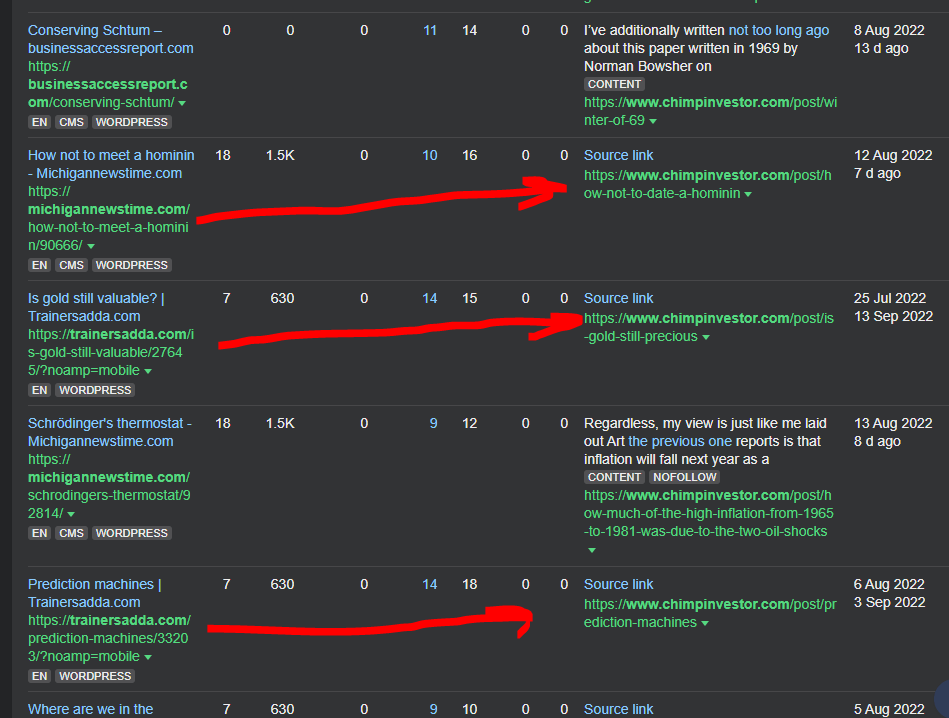
The bottom line: AI is a powerful tool for content creation when used responsibly — to enhance human expertise, not replace it. But using it to mass-produce link-building content is a shortcut that Google is actively penalising. Focus instead on creating original, expert-driven content that provides genuine value and naturally earns links.
28. Ignoring the Importance of Social Media and Brand Citations
Incorporating social media into your link-building strategy can be highly beneficial — and in 2026, its importance has grown to encompass the broader concept of brand citations and AI search visibility.
Here is why social media and brand citations matter for modern link building:
- Increased Exposure: Sharing your content on social media platforms exposes it to a larger audience, potentially leading to more shares, engagement, and ultimately more backlinks.
- Brand Citation Building: Every time your brand is mentioned on social media, forums, industry publications, or news sites — even without a link — it contributes to your brand’s citation profile. AI search engines like Google’s AI Overviews, ChatGPT, and Perplexity use these brand citations to assess authority and determine which brands to recommend.
- Engagement and Relationship Building: Social media allows for direct engagement with your audience and industry peers. By actively participating in conversations and sharing valuable insights, you can build relationships that lead to natural editorial links and mentions.
- Opportunities for Collaboration: Social media provides opportunities to collaborate with influencers, brands, and other content creators. These relationships can generate valuable backlinks and brand mentions across multiple platforms.
- AI Search Visibility Signals: While the direct impact of social signals on traditional rankings is debated, there is strong evidence that brand presence across social platforms contributes to the entity signals that AI search systems use to evaluate trustworthiness and authority.
To leverage social media and brand citations effectively, consider the following strategies:
- Share high-quality content regularly across your social channels.
- Engage with your audience by responding to comments, asking questions, and initiating discussions.
- Build relationships with influencers and industry experts by participating in relevant conversations.
- Create shareable content formats such as infographics, videos, and original research that are more likely to be shared and cited.
- Monitor brand mentions across the web and nurture unlinked mentions into linked citations where possible.
- Contribute thought leadership to industry publications and podcasts to build brand citations that strengthen your AI search visibility.
By integrating social media and brand citation building into your link-building efforts, you can amplify the reach of your content and build the authority signals that both traditional and AI search engines rely on.
Conclusion
In 2026, building a strong backlink profile remains vital for SEO success — but the landscape has shifted significantly. Link building is no longer just about improving traditional rankings. It is now a core component of how AI search engines evaluate your brand’s authority, trustworthiness, and expertise.
By being aware of these 28 common pitfalls, you can ensure your strategy remains effective, avoids costly mistakes, and positions your brand for visibility in both traditional SERPs and the growing world of AI-powered search.
The businesses that succeed in link building in 2026 are those that focus on genuine value — earning links through exceptional content, real relationships, and authentic expertise — rather than chasing shortcuts that Google’s increasingly sophisticated algorithms are designed to catch.
At Agile, we can help your business build a link strategy that works for both traditional and AI search — driving better rankings, increased traffic, and genuine online visibility.

Our commitment to excellence is underscored by our recognition as a Top Link Building Company in the United Kingdom by Clutch.
Frequently Asked Questions
What are the biggest link building mistakes to avoid in 2026?
The biggest mistakes include buying links, using private blog networks (PBNs), relying on AI-generated link spam, ignoring link quality in favour of quantity, and neglecting brand citations. Google’s SpamBrain is far more sophisticated in 2026, making manipulative tactics riskier than ever. Focus on earning links through genuine value, expert content, and authentic relationship building.
How has AI changed link building in 2026?
AI has changed link building in two major ways. First, Google’s AI-powered spam detection (SpamBrain) is significantly better at identifying manipulative link patterns, including AI-generated guest posts and automated outreach. Second, AI search engines like Google AI Overviews, ChatGPT, and Perplexity now use link quality signals and brand citations to decide which brands to cite in their responses — making genuine, authoritative links more valuable than ever.
Do brand citations matter as much as backlinks for SEO?
In the context of AI search, brand citations (unlinked mentions of your brand across the web) are now nearly as important as traditional backlinks. AI search engines use brand citations to assess your entity’s authority and determine whether to recommend your brand in generative responses. A strong link building strategy in 2026 should incorporate both traditional backlink acquisition and broader brand citation building.
What is SpamBrain and how does it affect link building?
SpamBrain is Google’s AI-powered spam detection system. It analyses link patterns at scale to identify manipulative link-building practices such as paid links, PBNs, link exchanges, and AI-generated link spam. In 2026, SpamBrain is significantly more advanced, meaning that low-quality link-building tactics carry a much higher risk of detection and penalties, including manual actions and deindexing.
How many backlinks do I need to rank well?
There is no fixed number of backlinks needed to rank well. What matters far more than quantity is the quality, relevance, and diversity of your links. A handful of links from authoritative, topically relevant websites will outperform hundreds of links from low-quality sources. In 2026, E-E-A-T signals from your backlink profile carry significant weight in both traditional and AI search rankings.
Is guest posting still an effective link building strategy?
Yes, guest posting remains effective when done correctly. The key is to contribute genuine thought leadership to relevant, authoritative publications within your industry. Avoid mass-produced AI-written guest posts on irrelevant sites — Google’s spam detection systems flag these patterns quickly. Focus on quality over quantity, use mainly branded anchor links, and ensure your contributions add real value to the host site’s audience.
What is the safest way to build links in 2026?
The safest and most effective link building approach in 2026 focuses on earning links naturally through exceptional content, digital PR, thought leadership, and genuine relationship building. Create original research, comprehensive guides, and expert commentary that others want to reference. Build real relationships within your industry. Contribute to authoritative publications. And monitor both your backlink profile and brand citations to ensure a healthy, diverse link profile that satisfies both traditional and AI search algorithms.

Related
Articles
![What Is Entity-Driven SEO? A Practical Guide for Professional Services [2026]](https://www.agiledigitalagency.com/wp-content/uploads/2026/03/What-Is-Entity-Driven-SEO-1.avif)