 Digital Marketing BlogConsumer Behaviour Trends in 2026: What Professional Services Must Know
 Consumer Behaviour Trends in 2026: What Professional Services Must Know
The way people choose professional services has fundamentally shifted. Buyers in law, finance, consulting and technology no longer follow a neat, linear path from awareness to enquiry. They research across channels, consult AI assistants, scrutinise reviews and form opinions long before they ever pick up the phone.
For professional services firms, understanding these consumer behaviour trends is no longer a nice-to-have. It is a competitive necessity. The firms that adapt will attract higher-quality leads, build stronger reputations and convert more consistently. Those that ignore the shift risk becoming invisible in the very moments their ideal clients are making decisions.
In this article, we break down the most important consumer behaviour trends shaping 2026 — and, crucially, what professional services firms must do about each one.
Key Takeaways
- AI tools now influence how buyers shortlist professional services firms — your digital presence must be structured for both human readers and machine interpretation.
- Trust signals outweigh traditional advertising — credentials, case studies, author expertise and third-party validation carry more weight than ever before.
- Zero-click search is expanding rapidly — potential clients are forming opinions about your firm without ever visiting your website.
- Reviews and social proof have become essential decision drivers — for professional services, they now rival personal referrals in influence.
- Website speed, mobile experience and first impressions are non-negotiable — a slow or dated site communicates a lack of professionalism.
- Gen Z is entering B2B buying committees — their expectations around digital experience, transparency and values alignment are reshaping procurement.
- Privacy-first behaviour is mainstream — firms that respect data boundaries and communicate transparently will earn deeper trust.
1. AI-Influenced Purchase Decisions Are Reshaping the Buyer Journey
This is arguably the most significant consumer behaviour shift of 2026.
Buyers are no longer simply typing queries into Google and scrolling through results. They are asking AI assistants — ChatGPT, Gemini, Perplexity, Copilot — to recommend solicitors, compare financial advisers, shortlist IT consultancies and summarise the strengths of competing firms.
This changes everything.
Because when someone asks an AI tool to recommend a corporate law firm in London, the response is not based on who paid for the top ad slot. It is based on which firms have the clearest digital footprint: structured data, authoritative content, consistent brand mentions and well-defined expertise.
For professional services, this means your online presence must be legible not just to humans, but to machines. If AI cannot parse your services, understand your specialisms or identify your experts, you will not appear in these recommendations — regardless of how established you are offline.
If you want to understand how AI search engines decide which brands to surface, our guide on how to rank in Perplexity, ChatGPT and Gemini breaks down the mechanics.
What to do about it:
- Implement Organisation and Person schema markup across your website so AI systems can identify your firm and its people.
- Publish detailed service pages that clearly define what you offer, for whom and in which locations.
- Ensure your firm is mentioned consistently across industry directories, legal and financial publications, and professional platforms.
- Create thought leadership content that demonstrates genuine expertise — not surface-level commentary.
2. Trust Signals Have Become the New Currency
Trust has always mattered in professional services. But in 2026, the way trust is established has changed dramatically.
Prospective clients are no longer willing to take a firm at its word. They verify. They cross-reference. They look for signals that confirm credibility before they ever make contact.
The trust signals that matter most today include:
- Named author profiles with verifiable credentials and professional history
- Case studies and results that demonstrate real outcomes, not vague claims
- Industry accreditations and awards displayed prominently
- Third-party validation through press mentions, directory listings and client endorsements
- Consistent brand identity across every digital touchpoint
This is particularly important for law firms, where potential clients are often in stressful situations and making high-stakes decisions. They need to feel confident before committing. Our article on the science of trust and building stronger business connections explores the psychology behind why these signals work.
From a search perspective, Google’s E-E-A-T framework (Experience, Expertise, Authoritativeness, Trustworthiness) continues to gain influence. AI systems use similar heuristics. Firms that invest in visible, verifiable trust signals will outperform those that rely on reputation alone.
What to do about it:
- Build detailed author pages for every professional who contributes content, linking to their qualifications, publications and professional profiles.
- Publish case studies with measurable outcomes — not generic testimonials.
- Display accreditations, regulatory memberships and awards on service pages, not just the homepage.
- Invest in brand citations across authoritative platforms to strengthen your entity profile.
3. Zero-Click Discovery Is Changing How Firms Get Found
Here is a trend that many professional services firms have not yet grasped.
An increasing proportion of search interactions now resolve without the user clicking through to any website. Google’s AI Overviews, featured snippets, knowledge panels and People Also Ask boxes provide answers directly on the search results page. AI chatbots do the same outside of traditional search entirely.
For professional services, this creates both a challenge and an opportunity.
The challenge: if your strategy depends entirely on driving clicks to your website, you are missing the growing number of prospects who form impressions without clicking. The opportunity: if you optimise for visibility within these zero-click environments, you can build brand recognition and authority at scale.
Our detailed guide on zero-click search strategies for professional services outlines ten practical approaches to maintaining visibility when clicks are declining.
What to do about it:
- Structure content to answer specific questions concisely — use clear headings, bullet points and direct language that AI and featured snippets can extract.
- Implement FAQ schema on service pages so your answers appear directly in search results.
- Optimise your Google Business Profile with current information, categories and regular updates.
- Monitor your brand’s presence in AI-generated answers using tools that track generative search visibility.
4. Social Proof Has Evolved Beyond Testimonials
Social proof in 2026 is no longer limited to a carousel of client quotes on your homepage.
Today’s buyers look for proof across multiple channels and formats. They check LinkedIn for thought leadership and engagement. They search for podcast appearances and conference talks. They look at who your firm collaborates with, which publications feature your experts and whether your team actively contributes to industry conversations.
For professional services, this is a fundamental shift. A law firm partner who regularly publishes insightful analysis on LinkedIn and is quoted in legal trade press carries far more persuasive weight than an anonymous testimonial on a website. A financial adviser whose name appears in respected financial publications is inherently more trustworthy than one with no visible digital footprint.
This is where the concept of LinkedIn SEO and visibility for B2B leaders becomes directly relevant to business development.
What to do about it:
- Encourage senior professionals to maintain active, authoritative LinkedIn profiles with regular thought leadership.
- Pursue speaking engagements, podcast appearances and industry roundtable contributions.
- Showcase client outcomes through detailed case studies rather than generic praise.
- Embed social proof throughout the buyer journey — on service pages, landing pages and in email sequences — not just on a dedicated testimonials page.
5. Reviews Are Now a Make-or-Break Factor
Reviews have crossed the threshold from helpful to essential.
In the consumer world, reviews have long been decisive. In professional services, they were historically less prominent — buyers relied on referrals and reputation. That era is ending. Today, prospects actively seek out Google reviews, Trustpilot ratings, Clutch profiles and industry-specific review platforms before engaging with any firm.
And here is the critical point: AI systems also use review data as a trust signal. When an AI assistant is asked to recommend an accountancy firm in Manchester, the response is influenced by the volume, recency and sentiment of available reviews.
If your firm has few reviews — or worse, outdated ones — you are at a measurable disadvantage. Our article on whether Google reviews still matter in 2025 remains highly relevant and explains exactly why this channel deserves strategic attention.
What to do about it:
- Establish a systematic process for requesting reviews from satisfied clients at the conclusion of successful engagements.
- Respond to every review — positive and negative — with professionalism and genuine engagement.
- Diversify your review presence across Google, industry-specific platforms and professional directories.
- Never purchase or fabricate reviews. The risks of buying reviews are substantial and can permanently damage your firm’s reputation.
6. Website First Impressions Determine Whether Prospects Stay or Leave
Your website is not a brochure. It is your most important business development asset.
In 2026, when a prospective client lands on your site — whether through search, a referral link, a social media post or an AI recommendation — they make a judgment within seconds. That judgment is based not on what your copy says, but on how the site looks, loads and feels.
A slow-loading, visually outdated or confusing website communicates one thing: this firm is not keeping pace. For professional services, where trust and competence are everything, that impression is devastating.
The data consistently shows that users abandon sites that take more than three seconds to load. They disengage from pages with poor visual hierarchy. They leave when they cannot quickly find the information they need.
This is where the relationship between web design and SEO becomes impossible to ignore. A well-designed site does not just look good — it performs better in search, retains visitors longer and converts at a higher rate.
At Agile Digital Agency, we consistently see that professional services firms investing in modern, performance-optimised websites experience significant improvements in both organic visibility and lead quality. The website is where every other marketing effort either succeeds or fails.
What to do about it:
- Audit your Core Web Vitals — Largest Contentful Paint, Interaction to Next Paint and Cumulative Layout Shift. Our guide on Core Web Vitals and SEO provides a practical starting point.
- Ensure your homepage clearly communicates who you serve, what you do and why prospects should trust you — within the first visible section.
- Simplify navigation. Reduce cognitive load. Make it effortless for visitors to find service information, team profiles and contact details.
- Invest in professional photography and visual design that reflects the calibre of your firm.
7. Mobile-First Behaviour Is No Longer Optional — It Is Default
Mobile-first is not a trend. It is the established baseline.
The majority of initial research — including for B2B professional services — now begins on a mobile device. A managing director searching for a new compliance consultancy may start that search on their phone during a commute. A startup founder comparing tech consultancies may begin on a tablet between meetings.
If your website delivers a substandard mobile experience — tiny text, awkward navigation, forms that are painful to complete on a small screen — you are losing prospects at the earliest and most critical stage of the buyer journey.
Google has fully transitioned to mobile-first indexing, meaning it predominantly uses the mobile version of your site for ranking and indexing. If your mobile experience is poor, your search visibility suffers across all devices.
What to do about it:
- Test your site on multiple mobile devices — not just through browser developer tools, but on actual phones and tablets.
- Ensure contact forms are short, tap-friendly and functional on mobile. Click-to-call buttons should be prominent.
- Compress images and leverage modern formats like WebP and AVIF to maintain fast load times on mobile connections.
- Prioritise legibility: adequate font sizes, generous spacing and clear visual hierarchy on smaller screens.
8. Gen Z Is Entering B2B Buying Roles
This is a trend that many professional services firms are underestimating.
The oldest members of Generation Z are now in their late twenties. They are stepping into procurement roles, management positions and decision-making committees. In some sectors — particularly technology, digital services and startups — they are already the primary buyers.
Gen Z buyers approach purchasing decisions differently from their predecessors. They are digital natives who expect seamless online experiences. They are sceptical of corporate jargon and value authenticity over polish. They research extensively before engaging, often relying on peer recommendations, social media content and AI tools rather than traditional sales channels.
For professional services, this means the old playbook of relationship lunches and formal pitches is no longer sufficient on its own. You need a compelling digital presence, accessible thought leadership and a brand voice that feels genuine rather than formulaic.
This generation also places significant weight on values alignment. They want to work with firms that demonstrate commitment to sustainability, diversity and ethical practice — not just in marketing materials, but in visible, verifiable actions.
What to do about it:
- Ensure your digital presence is polished and modern. An outdated website or inactive social media presence will immediately disqualify you in the eyes of younger decision-makers.
- Publish content in varied formats — short-form video, infographics, interactive tools — not just long-form articles and whitepapers.
- Be transparent about your firm’s values, culture and approach to social responsibility.
- Make it easy to engage digitally. Chatbots, online scheduling and self-service information should complement traditional contact methods.
9. Privacy-First Consumers Demand Transparency
Privacy is no longer a regulatory checkbox. It is a consumer expectation — and in professional services, it is closely linked to trust.
The deprecation of third-party cookies, increasingly strict data protection regulations and growing public awareness of data practices have created a buyer who is vigilant about how their information is collected, stored and used. In sectors such as law and finance, where confidentiality is paramount, this scrutiny is especially intense.
Firms that handle data carelessly — or even appear to — risk damaging the trust that underpins their entire client relationship. Aggressive retargeting, opaque cookie policies, excessive form fields and unclear data processing statements all erode confidence.
Conversely, firms that lead with transparency — clear privacy policies, minimal data collection, explicit consent mechanisms and visible security credentials — differentiate themselves in a market where trust is the ultimate competitive advantage.
What to do about it:
- Review your cookie consent mechanism. Ensure it is genuinely compliant and respects user preferences, not designed to manipulate acceptance.
- Minimise form fields. Only ask for information you genuinely need at each stage of the enquiry process.
- Invest in first-party data strategies. Build direct relationships through valuable content, newsletters and gated resources rather than relying on third-party tracking.
- Display security credentials, regulatory compliance badges and clear data handling statements on key pages.
How Professional Services Firms Should Respond
Understanding these consumer behaviour trends is the first step. Acting on them is what separates firms that grow from those that stagnate.
Here is a practical framework for responding to these shifts:
Step 1 — Audit Your Digital Foundation
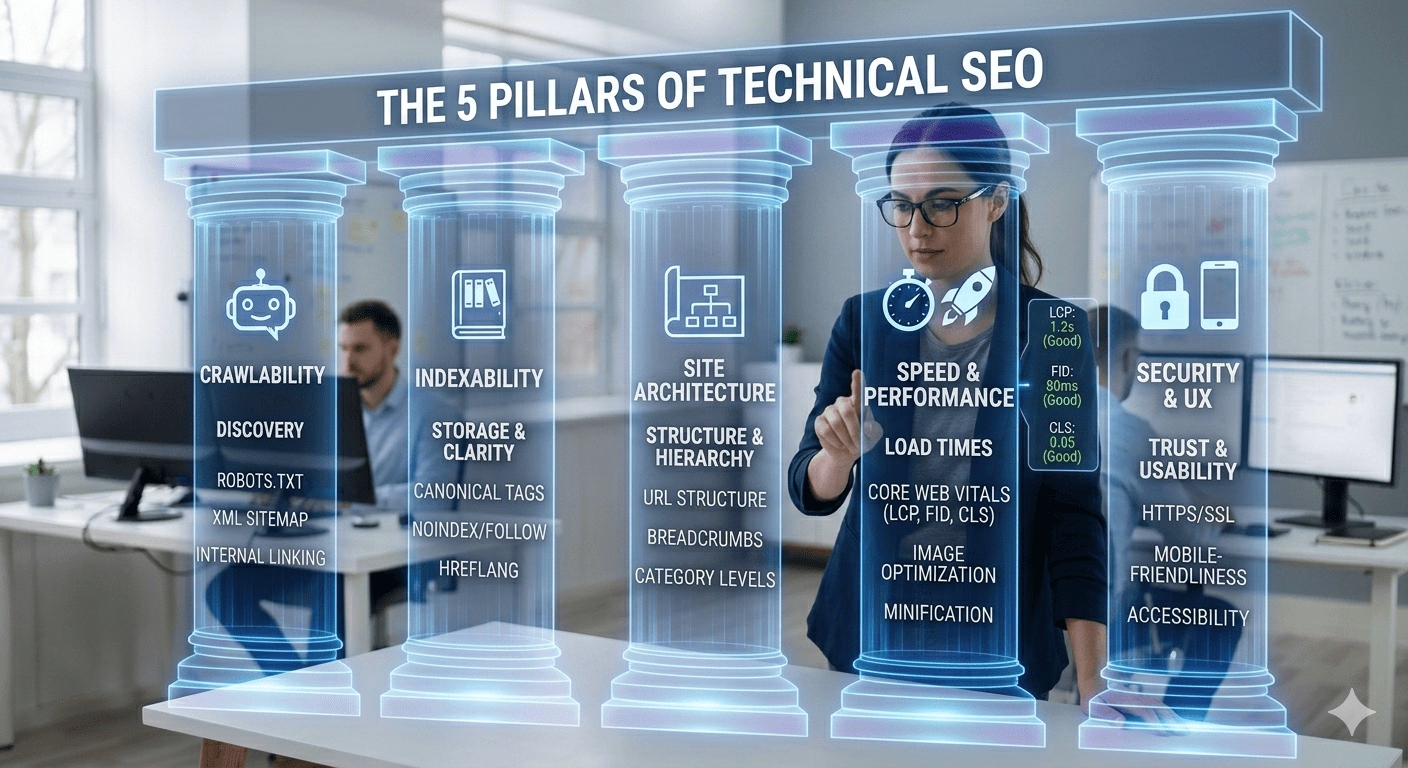
Before pursuing any new strategy, ensure your fundamentals are solid. That means a fast, mobile-optimised website with clean technical SEO, structured data implemented correctly and a clear information architecture. Our guide to technical SEO optimisation for small businesses provides a thorough starting point.
Step 2 — Build Your Entity Profile
AI systems need to understand who you are, what you do and why you are authoritative. This requires consistent naming, comprehensive structured data, detailed author profiles and presence across relevant directories and platforms. Think of it as building a digital identity that machines can read as clearly as humans can.
Step 3 — Create Content That Demonstrates Expertise
Surface-level blog posts will not cut it. Professional services buyers are looking for depth, specificity and practical value. Publish content that addresses real challenges your clients face, draws on your firm’s genuine experience and offers actionable guidance. The firms that approach content as thought leadership — not as a tick-box SEO exercise — will see the strongest results.
Step 4 — Invest in Visibility Beyond Your Website
Your website is the hub, but visibility must extend outward. Pursue brand citations in industry publications. Maintain active professional profiles. Contribute to relevant discussions on LinkedIn and in trade media. The broader your authoritative footprint, the more likely AI systems and human buyers alike are to discover and trust your firm.
Step 5 — Measure What Matters
Traditional metrics — rankings, traffic, click-through rates — remain valuable. But in 2026, you should also track:
- Your firm’s visibility in AI-generated search responses
- Brand mention frequency across authoritative sources
- Review volume, recency and sentiment across platforms
- Engagement with thought leadership content
- Conversion quality — not just quantity of enquiries, but the calibre of leads arriving through digital channels
If you are working with a digital agency, ensure they understand the nuances of professional services marketing. Our article on winning clients in the messy middle explores how SEO and UX strategies must work together to guide complex B2B buyer journeys.
Frequently Asked Questions
How are consumer behaviour trends in 2026 different from previous years?
The most significant shift is the role of AI in the buyer journey. Consumers and business buyers now use AI assistants to research, compare and shortlist professional services providers. This means firms must optimise for machine readability and entity recognition alongside traditional SEO and marketing. Additionally, zero-click search, Gen Z entering B2B roles and heightened privacy expectations are accelerating changes that were only emerging in prior years.
Why do consumer behaviour trends matter for professional services firms specifically?
Professional services operate in trust-based markets where the buyer journey is longer and more research-intensive than in retail. Clients are making high-stakes decisions — choosing a solicitor, accountant or technology partner — and they apply greater scrutiny. Understanding how these buyers discover, evaluate and select providers is essential for attracting the right clients through digital channels.
How can a law firm or financial services company adapt to AI-influenced buying behaviour?
Start by ensuring your firm has a clear digital entity profile: structured data on your website, detailed author pages for key professionals, consistent brand citations across directories and publications, and authoritative content that demonstrates genuine expertise. These elements help AI systems understand, trust and recommend your firm when buyers ask for suggestions.
What is zero-click discovery and how does it affect professional services?
Zero-click discovery occurs when a user finds the information they need directly on a search results page or through an AI-generated response without clicking through to a website. For professional services, this means potential clients may form opinions about your firm based solely on what appears in AI overviews, featured snippets and knowledge panels. Optimising for these surfaces is now critical.
How important are online reviews for professional services firms in 2026?
Extremely important. Reviews now influence both human decision-making and AI recommendations. A strong portfolio of recent, genuine reviews across Google, industry directories and professional platforms signals trustworthiness to both prospective clients and the algorithms that power AI search. Firms with few or outdated reviews are at a measurable disadvantage.
What should professional services firms prioritise first when adapting to these trends?
Begin with your digital foundation: a fast, mobile-optimised website with clean technical SEO and implemented structured data. Then focus on building trust signals — author profiles, case studies, reviews and brand citations. Finally, invest in content that demonstrates genuine expertise and visibility across the platforms where your ideal clients are researching.
Final Thoughts
Consumer behaviour in 2026 is defined by a single overarching theme: buyers are more informed, more discerning and more empowered than at any point in history. They have AI tools that compare options in seconds. They have access to reviews, credentials and thought leadership that lets them evaluate firms without ever making direct contact. They have expectations around speed, transparency and digital experience that are only growing.
For professional services firms — whether in law, finance, consulting or technology — this is not a threat. It is an enormous opportunity.
The firms that invest in understanding how their ideal clients behave, research and make decisions will attract better leads, build deeper trust and grow more sustainably. Those that dismiss these trends as irrelevant to their sector will find themselves increasingly invisible in the very moments that matter most.
The buyer journey has changed. The question is whether your firm’s digital presence has changed with it.
If you are unsure where to start, Agile Digital Agency works with professional services firms across the UK to align digital strategy with how today’s buyers actually behave. From technical SEO and web design to content strategy and AI search visibility, we help firms become findable, credible and chosen.

Related
Articles
![What Is Entity-Driven SEO? A Practical Guide for Professional Services [2026]](https://www.agiledigitalagency.com/wp-content/uploads/2026/03/What-Is-Entity-Driven-SEO-1.avif)