Find out what a signed case really costs you, and which channels bring them in
For personal injury, workers' comp and other contingency-fee firms. We trace every way a client reaches you, check the data behind your reports, and give you a cost per signed case for every channel you pay for.
- Fixed price from $2,900, quoted in writing before we start
- Delivered within one week of receiving access
- Starts with a free tracking scan: no access needed



Get your free tracking scan
Who the review is for
Owners and partners of small and mid-size US law firms working on contingency, mostly personal injury and workers’ comp, who:
- Spend $5,000 or more a month on marketing, with Google Ads as a main channel
- Get most new clients by phone, not by form
- Run intake in Lead Docket, Filevine, Litify, Clio Grow or a similar system
- Get reports from their agency and their intake team that never quite agree
- Can’t say with confidence what a signed case cost last month, by channel
Three systems, three different answers, and none of them is your signed cases
Google Ads counts conversions. Your call tracking counts calls. Your intake system counts signed cases. They rarely agree, and the gap is usually bigger than firms expect. In one month at a workers' comp firm we reviewed:
8.5
times more conversions reported by Google Ads than signed cases from paid search
2
times as many calls credited to Google Ads by call tracking as came in on ad numbers
48%
of signed cases had a source only because someone in intake typed it in
25%
swing in Google Ads' cost per signed case, depending on whether a handful of cases with no ad click behind them count
Reporting is only as good as the data behind it
Every one of those systems was working as designed. Each was simply counting something different. A dashboard, an agency report or a spreadsheet can only show the numbers it is given, and three common gaps make a report look precise and still be wrong.

Existing clients counted as new
Ad calls from existing clients are counted as conversions, so the ad account takes credit for work you already had.
One click, credited forever
A caller’s first ad click follows them onto every later call, so one paid visit can claim several cases.

Source picked from memory
Lead source is a dropdown someone fills in from memory at intake, often days after the first contact.
Budget follows the report
Ad platforms optimize toward whatever you count as a conversion, so they buy more of the cheap calls and fewer of the cases you want. Channels that look expensive get cut, and channels that look cheap get more money, on numbers that never matched your signed cases.
Before anyone can tell you what a channel costs, someone has to decide which records to trust. That’s what the review does.
What the review checks
We follow every path a client can take to your firm, test whether its source survives all the way to a signed case, and then match what you spend against what you sign.

Website tracking
GA4, Google Tag Manager, form and chat conversions and consent settings. We compare what fires for a normal visitor with what fires for a visitor arriving from an ad.

Call tracking
CallRail or your call tracking platform, number pools, dynamic number swapping and whether the ad click ID reaches the call record. Most injured clients call, so this is where most attribution is lost.

Every other phone line
Your main office number, your Google Business Profile listing, your intake system’s own number, after-hours answering services and office lines that call your own tracking numbers by mistake.

Google Ads
Conversion actions, duplicate or inflated counts, credit given to the wrong campaigns, and whether signed cases are sent back to Google Ads with a case value.

Intake system
How leads arrive, how source is recorded and whether it stays attached from first contact to signed case.

Every channel you pay for
Local Services Ads, TV, billboards, attorney referrals, directories and SEO. We match each channel’s spend to the signed cases your intake system credits to it.

Signed-case reconciliation
We take your recent signed cases and trace each one back to its source, so you see how many your data can explain and how many rest on memory.
What you get
Five deliverables, written in plain language so your team, your agency or another firm can act on them.
Cost per signed case snapshot
For one recent full month, your spend, leads, signed cases, cost per lead and cost per signed case for every channel you pay for. It shows how many of your signed cases are traced to a source by data, how many rely on what intake entered, and how many are unknown. Every channel is measured the same way, including any we manage.
Entry path map
A diagram of every route a client takes to your firm (each campaign, phone number, form, chat and referral source) and where each one connects to, or drops out of, your intake system. See a sample
Data problems list
Every problem we find, ranked by how much it distorts your numbers, with the evidence behind it and what it stops you from seeing.
Fix plan and quote
Each fix with an effort estimate and a fixed price. Use it with us, your agency or your own team.
Walkthrough call
A 60-minute session to go through the findings and agree what to fix first.
What the snapshot accounts for
Referrals aren’t free
Attorney referrals usually carry a fee share, typically 25 to 33% of the attorney’s fee. The snapshot costs them with your actual fee share, or with that benchmark if you don’t track it. Referrals from former clients, doctors and friends count at no cost. Treat every referral as free and your cheapest-looking channel can turn out to be one of your most expensive.
Cases sign late
Some leads from the snapshot month will still sign after we deliver it. We mark which figures are still likely to move, so nobody cuts a channel on a number that isn’t final.
A sample from a real review
These findings come from a review we ran for a single-office workers’ comp firm, with names, numbers and figures removed.
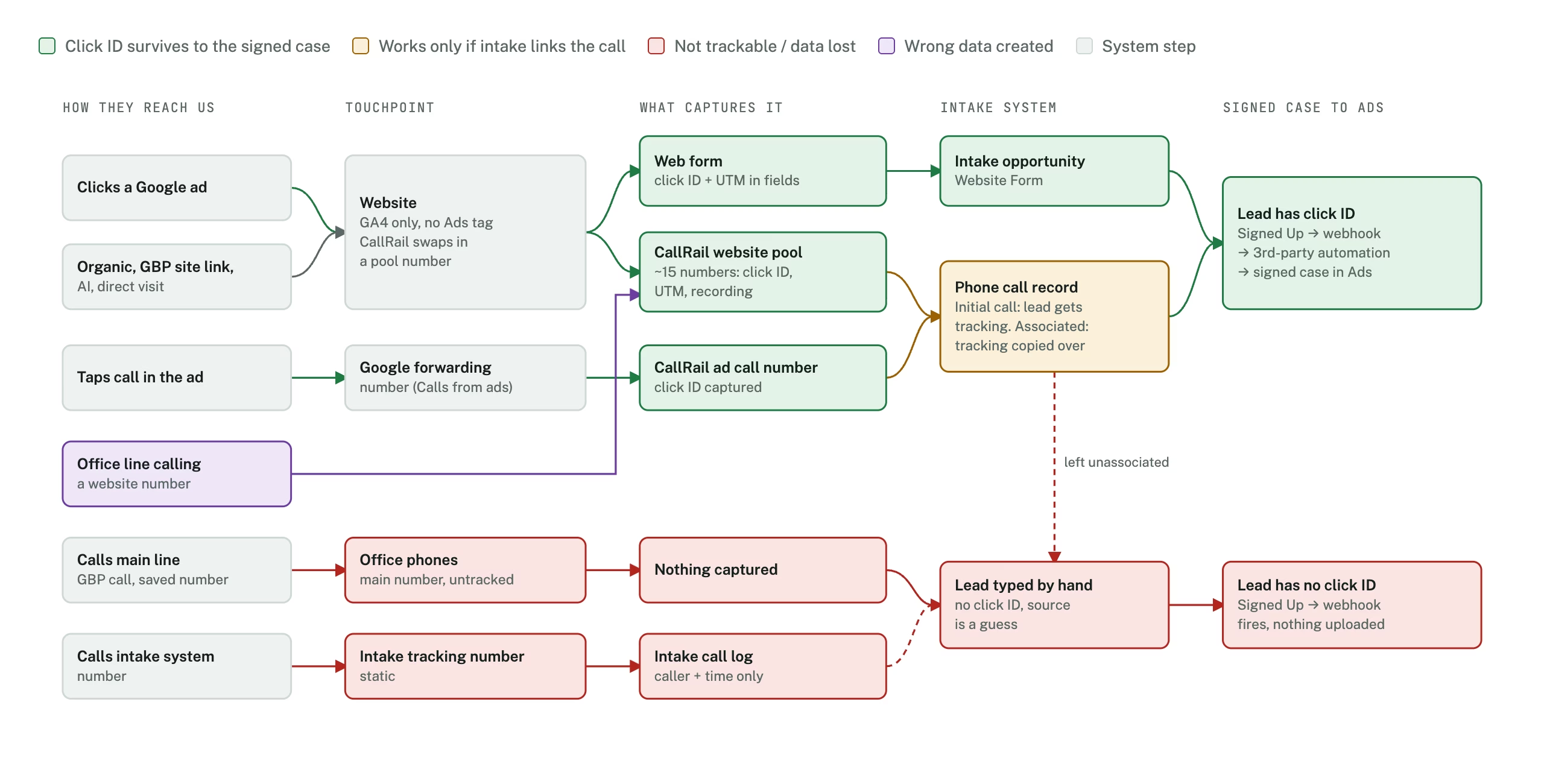
Of nine ways a client could reach that firm, only one reliably carried the ad click through to the signed case. Two depended on intake linking a call by hand, three could not be tracked at all, and one was creating false paid calls from the firm’s own office phones.
The snapshot for the same firm showed:
- 48% of signed cases traced to a source by data, 48% by what intake entered, 4% unknown.
- Google Ads reporting about 8.5 times more conversions than paid search signed cases.
- Google Ads giving credit for signed cases to the wrong campaigns, enough to point a budget decision the wrong way.
- Organic and AI search signing cases at about a sixth of the cost per case of paid search, and bringing in roughly one in five signed cases.
We also run that firm’s SEO, which is exactly why we measure it as strictly as their ads. How we approach SEO and AI search for law firms
Built on real intake data, not one platform
Our deepest experience is with firms running Lead Docket, CallRail and Google Ads. But leaks rarely happen inside a single platform. They happen in the handoffs: between the ad and the call, the call and the lead, the lead and the signed case.
Those handoffs exist in every stack. The method is the same whether your intake runs on Filevine, Litify, Clio Grow or Lawmatics, and whether you track calls with CallRail, CallTrackingMetrics or WhatConverts. If your setup includes a platform we haven’t reviewed before, we’ll say so on the scan call and allow for it in the fixed price.
Price, scope and timing
From $2,900, fixed fee
The base price covers one office, one intake system, your website, your Google Ads account, your call tracking and a cost per signed case snapshot across every channel you pay for.
Firms with several offices, more than one intake or case system, or a wider mix of ad platforms get a fixed quote after the free scan, before any commitment. You always know the price before we start.

Delivered within one week
We deliver the snapshot, the entry path map and the fix plan within one week of receiving read-only access.

About two hours of your time
Around two hours in total, covering a kickoff call, granting read-only access, sending last month’s spend for channels outside Google Ads, and the walkthrough call.
How it works

Free tracking scan
We check your website from the outside, as a normal visitor and as a visitor from an ad, and share what we find on a short call. No access needed.

Scope and price in writing
You get the fixed price and timeline before anything starts.

Read-only access and spend
You grant viewer access to GA4, Tag Manager, Google Ads, your call tracking and your intake system, and send last month’s spend for your other channels.

The review
We map every entry path, place test calls and form submissions, trace your recent signed cases back to their sources and work out what each channel costs per signed case.

Walkthrough and fix plan
Within a week, we take you through the findings and hand over the snapshot and the fix plan, with a fixed quote for each fix.
What the review does not include
Not included
- Implementation.
We don’t change your live systems during the review. Every fix is listed and priced in the fix plan, and you choose who does it. - Ad management or SEO.
We check whether your channels are measured correctly, not run them. - Legal or bar-advertising advice.
Anything that touches advertising rules or referral fee arrangements is flagged for your own counsel. - Intake staff coaching.
Where the data shows intake inconsistencies, we report them. We don’t grade your team.

Frequently asked questions
We already have a marketing agency. Is this for us?
Yes. The review sits alongside your agency, not in place of it. It gives you an independent check of whether the numbers they report match the cases you actually sign.
Why not just buy a reporting dashboard?
A dashboard shows the numbers it is given. If your conversions are double counted and your lead sources are picked from memory, it will show those numbers, beautifully. The review fixes what goes in, so any dashboard you use, now or later, shows numbers you can trust.
You run SEO for some firms. Can you review a channel you manage?
Yes, and we hold it to the same standard. The snapshot measures every channel the same way, from spend to signed case, and we tell you which channels we run. If our own channel isn’t paying off, the numbers will say so.
Do we have to hire you for the fixes?
No. The fix plan is written so your team, your agency or another firm can carry it out. If you want us to do it, each fix already has a fixed price.
Which systems do you work with?
GA4, Google Tag Manager, Google Ads and any mainstream call tracking and intake platform. Our most in-depth work has been on CallRail and Lead Docket: we built and published Agile Form Connector for Lead Docket, a free WordPress plugin that sends Contact Form 7 enquiries, with their source and tracking values, straight into Lead Docket. If you use something else, tell us during the free scan and we’ll confirm scope before you commit.
Do you cover Local Services Ads, Meta, TV and billboards?
Yes, in the cost per signed case snapshot: we match each channel’s spend to the signed cases your intake system credits to it. The detailed tracking review focuses on Google Ads, where most personal injury budgets go. If Local Services Ads or Meta make up a large share of your spend, mention it on the scan call and we’ll include them in the quote.
How do you cost referrals?
Attorney referrals are costed with the fee share you pay, or with a typical 25 to 33% of the attorney’s fee if you don’t track it. Referrals from former clients, doctors and friends count at no cost. We don’t advise on referral fee arrangements; those questions go to your own counsel.
We’re not a PI or Workers’ Comp firm. Can you still help?
If you work on contingency, advertise and sign most clients by phone, the same problems apply. Mass torts, employment and medical malpractice firms run into them too.
Why is the price “from” $2,900?
$2,900 covers a single-office firm with one intake system. Larger setups take longer to trace, so we quote them after the free scan. The price is fixed and agreed before we start.
How much of our time does it take?
Around two hours: a kickoff call, granting access, sending last month’s spend and the walkthrough at the end. We do the rest.
How do you handle our data?
We work with read-only access to your accounts and sign an NDA on request. We don’t need access to client case files.
What if our tracking turns out to be fine?
Then you have a cost per signed case you can rely on and a documented baseline, which is useful the next time you change agencies, platforms or budgets.
See what a signed case really costs you
Start with the free tracking scan. It shows whether your ad visitors are tracked differently from everyone else. If there's a gap worth reviewing, we'll tell you what the full review would cost before you commit.