Digital Marketing BlogThe Citation Gap: Why AI Mentions Your Brand but Doesn’t Link to You
 The Citation Gap: Why AI Mentions Your Brand but Doesn’t Link to You
Let’s address something most firms are only just starting to notice.
Your brand is being mentioned in AI-generated answers.
But you are not being cited as the source.
When a prospective client asks a generative search engine a complex question about your sector, your firm may appear in the response. However, the clickable reference often points elsewhere — to a directory, a media site, or a competitor who has structured their content more effectively.
You receive the brand mention.
Someone else receives the authority and the click.
This is what we call the Citation Gap.
It is the gap between being a recognised entity and being a trusted, citable source.
And as search evolves from ranking links to synthesising answers, that gap becomes commercially significant.
From Visibility to Verifiability
Traditional SEO focused on visibility:
- Rank higher
- Drive traffic
- Improve click-through rate
Generative search changes the emphasis.
Large language models and AI-powered search interfaces do not simply rank pages. They extract, synthesise and reference information based on signals of clarity, structure, authority and consistency.
In other words, the question is no longer:
“Can you rank?”
It is now:
“Can you be verified and extracted?”
If an AI system cannot confidently associate a fact with your domain in a structured way, it will default to citing a more easily extractable source — often a large aggregator or directory.
That is how firms become invisible authorities.
The New Metric: Share of Model
Most organisations still track rankings and traffic. Those remain important.
But in the era of AI-assisted search, another metric matters:
Share of Model (SoM).
Share of Model refers to the proportion of high-value AI prompts in your sector where your firm is cited as the primary or supporting source.
You may rank highly in traditional search and still have a low Share of Model.
That signals a structural issue:
- Your brand is recognised
- Your expertise is referenced
- But your domain is not treated as the canonical source
If you are not the cited authority, you are contributing to the information ecosystem without capturing the commercial value.
Why the Citation Gap Happens
There are typically four causes.
1. Content Is Written for Keywords, Not Extraction
Many pages are optimised to rank, not to be lifted and cited.
Dense paragraphs, blended ideas, and marketing-heavy language make it difficult for AI systems to isolate clear, factual statements.
2. Weak Entity Signals
Search engines and knowledge graphs rely on entity consistency.
If your firm’s name, expertise, services and positioning vary across:
- Your website
- LinkedIn profiles
- Industry directories
- Press coverage
Then AI systems may reduce confidence in citing you directly.
3. Aggregator Advantage
Large publishers and directories often:
- Structure information clearly
- Use consistent formatting
- Present concise summaries
- Maintain strong technical SEO
Even if your insight is original, their structure may be easier to extract.
4. Lack of Proprietary Insight
Generative systems prioritise content that offers:
- Unique data
- Defined methodologies
- Clear frameworks
- Original research
If your content mirrors general industry consensus without adding something distinctive, there is less reason to cite you.
How to Close the Citation Gap
Closing the gap requires shifting from “ranking strategy” to “extraction strategy”.
Here is a practical framework.
1. Build Citable Content Blocks
AI systems favour modular clarity.
For high-intent topics, structure your pages as follows:
Query-Matched Header (H2 or H3)
Mirror real user questions, for example:
How do mid-sized law firms implement AI in eDiscovery?
Concise 40–70 Word Summary Immediately Below
Provide a factual, standalone answer. No fluff. No sales language.
This is your extraction layer.
Evidence Layer Beneath the Summary
Support the claim with:
- Case data
- A defined framework
- A proprietary methodology
- A practical breakdown
This three-part structure increases the likelihood that your domain becomes the referenced source.
2. Strengthen Entity Infrastructure
Entity-driven optimisation goes beyond keywords.
At minimum, ensure:
- Consistent firm name usage across all digital properties
- Structured data (Organisation, Person, Service schema)
- Accurate sameAs references linking to authoritative profiles
- Clear description of services and expertise
Your technical foundation should make it unambiguous:
Who you are
What you do
Where you operate
What you are known for
When entity signals are stable, AI systems have higher confidence in grounding statements to your domain.
3. Publish Authoritative, Attributable Insights
If you want to be cited, you must publish material worth citing.
Examples for professional services:
- Defined frameworks (named and explained clearly)
- Benchmark studies within your niche
- Legal or regulatory interpretation with structured summaries
- Case-based breakdowns of complex problems
Avoid generic thought leadership.
Specificity wins citations.
4. Align Brand Claims Across the Web
If your website positions you as a “specialist AI advisory firm” but external profiles describe you differently, you dilute authority.
Audit:
- Leadership bios
- Company descriptions
- Media mentions
- Directory listings
Ensure thematic consistency.
AI systems prioritise stability.
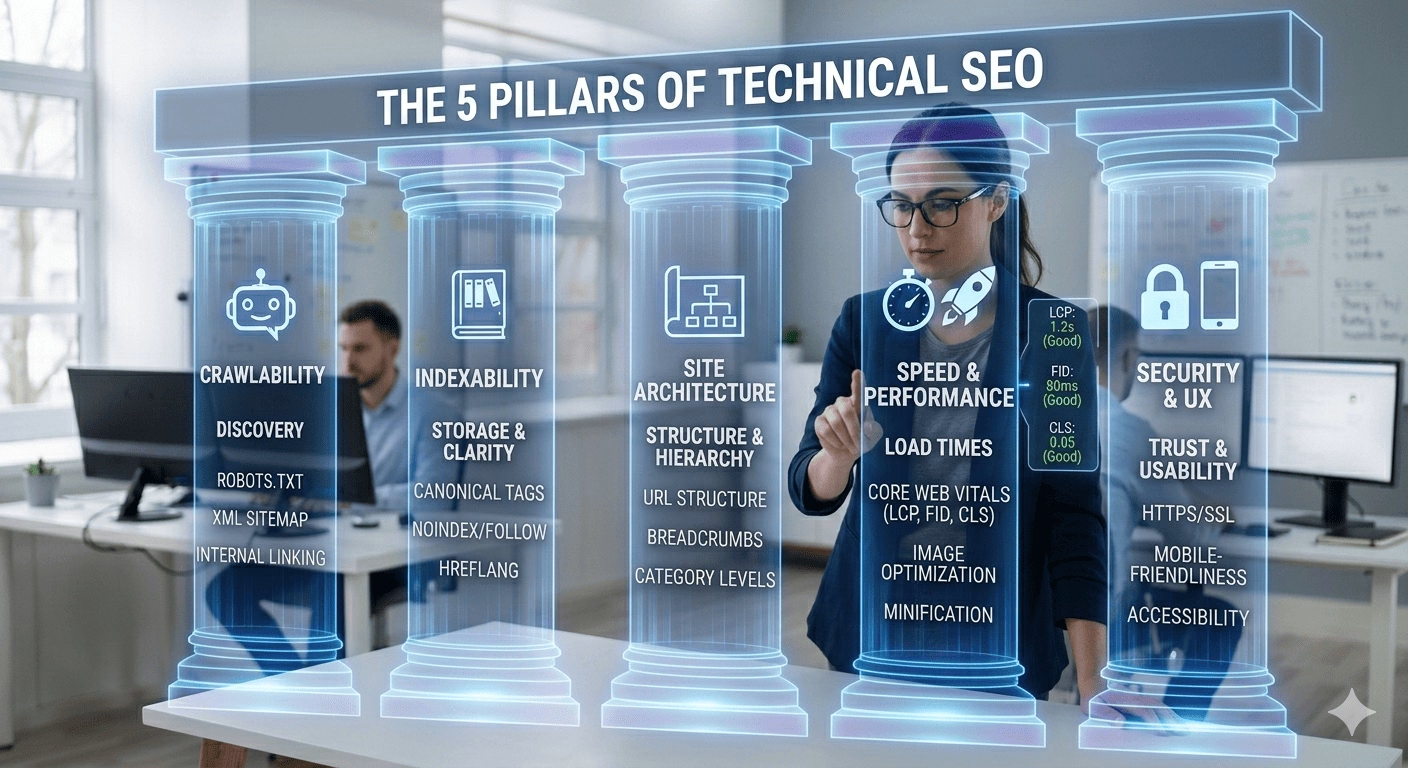
5. Maintain Technical Clarity
Your technical foundation still matters.
Ensure:
- Clear page hierarchy
- Logical internal linking
- Clean HTML structure
- Fast load speed
- Crawlable architecture
- No conflicting canonical signals
Extraction depends on accessibility.
If your site is technically ambiguous, it becomes harder to cite confidently.
The Strategic Advantage for Professional Services Firms
For law, finance, consultancy and technology firms, this shift presents an opportunity.
Large competitors often focus on scale.
Smaller, specialist firms can focus on precision.
By:
- Publishing clearly structured expert content through topic clusters
- Building strong entity signals
- Maintaining consistency across digital properties
- Framing insights as attributable frameworks
You increase the probability of becoming the cited authority — not merely the mentioned brand.
And in high-value professional services, the cited authority wins trust.
Are You an Invisible Authority?
If your brand appears in AI-generated discussions but your domain is rarely referenced directly, you may have a Citation Gap.
The question is not whether AI will influence client research.
It already does.
The question is whether your firm will be treated as:
- A background mention
or - A primary source
Closing that gap requires deliberate structural change.
The era of optimising only for rankings is ending.
The era of optimising for citation and extraction has already begun.
Close the Gap — Before Your Competitors Do
At Agile Digital Agency, we help professional services firms build the entity authority, structured content, and technical foundations needed to become the cited source — not just the mentioned brand. Talk to us about your AI visibility strategy.

Related
Articles
![What Is Entity-Driven SEO? A Practical Guide for Professional Services [2026]](https://www.agiledigitalagency.com/wp-content/uploads/2026/03/What-Is-Entity-Driven-SEO-1.avif)