Digital Marketing BlogAI-First SEO Agency vs Traditional SEO Agency: 7 Key Differences
 AI-First SEO Agency vs Traditional SEO Agency: 7 Key Differences
The label “AI-first SEO agency” is increasingly common, but the actual differences from a traditional agency are not always clear. This post breaks down seven concrete differences across delivery, output, reporting and pricing, with a side-by-side table at the end and guidance on which one fits your situation.
If you are still working out what an AI-first agency even is, our pillar piece on what an AI-first SEO agency means is the right starting point.
1. How They Use AI in the Delivery Process
Traditional agencies use AI as an occasional helper. A strategist might paste an export into ChatGPT to summarise it, or use Surfer to score a brief. Most of the work still happens manually in spreadsheets, in Google Docs, in calls.
AI-first agencies build AI agents into the workflow. Code-aware AI parses log files, runs gap analysis across thousands of URLs, validates schema at scale, and generates technical recommendations from raw GSC data. The senior strategist supervises, interprets and decides – but the heavy lifting that used to take a week now takes hours.
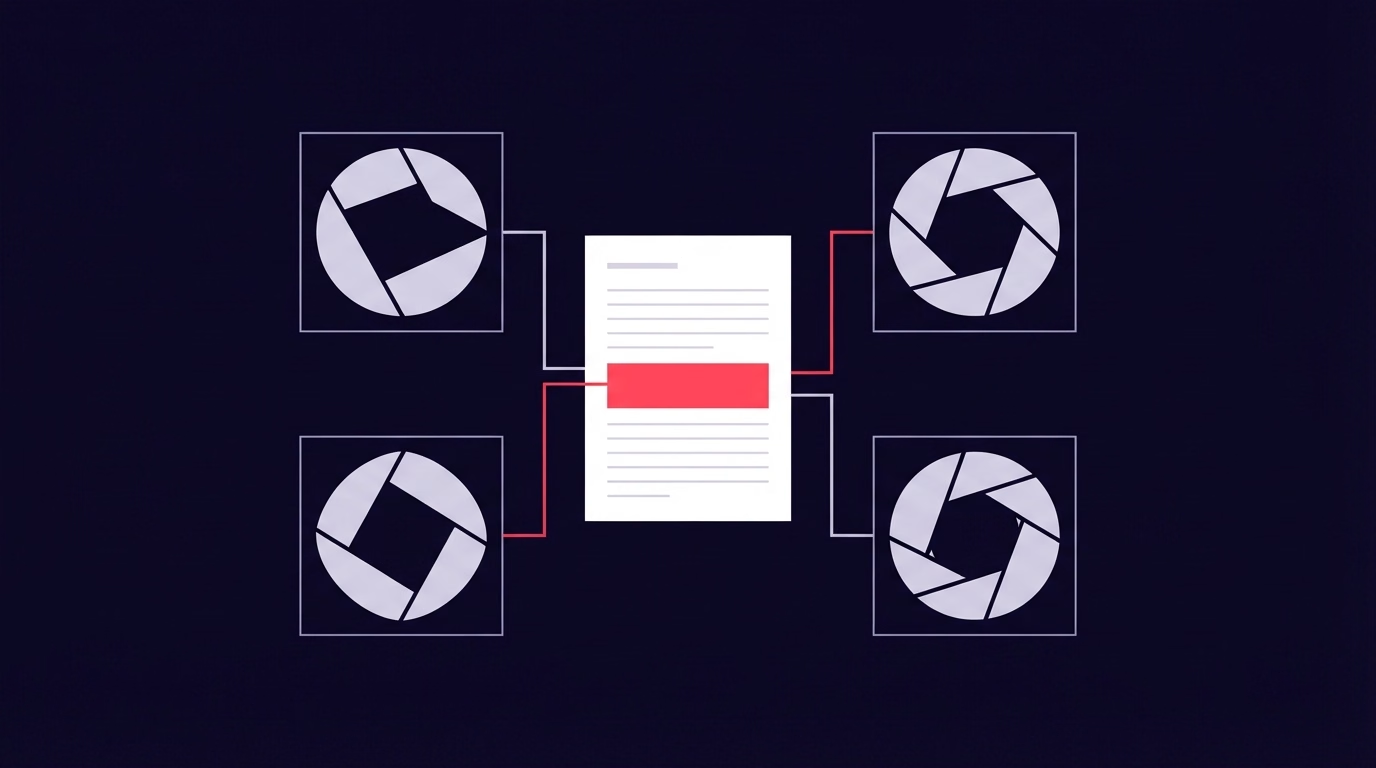
To make this concrete: we have built our own AI-powered audit pipeline that connects directly to Ahrefs, Google Analytics 4, Google Search Console and Google PageSpeed, scrapes the site for structure, meta, content and AI-readiness signals, and queries Perplexity, ChatGPT and Gemini in the same run to surface how the brand is currently being represented in AI answers. The output is a single cross-referenced view – what the SEO data says, what the technical data says, what the AI engines actually return, all in one place – that a senior strategist then interprets and turns into a prioritised plan. The traditional version of this work meant six tools, four tabs, a human mentally connecting the dots, and an outcome only as thorough as the strategist’s patience. The AI-first version takes hours instead of days, and surfaces the AI-visibility gap that traditional audits miss entirely.
2. What They Optimise For
Traditional SEO targets Google blue-link rankings. That is still important, but it is no longer the whole game.
AI-first SEO targets two layers at once: Google rankings AND visibility on AI search engines (ChatGPT, Perplexity, Google AI Overviews, Gemini). Each of those engines weighs sources slightly differently – freshness, authority, structured extractability, citation provenance – but they consistently favour content that is structured, authoritative and clearly extractable. AI-first delivery means optimising structured data for entity recognition, building content formats AI engines cite, and tracking citations as a measurable outcome.
The mental model has changed: from “rank on page one” to “be the answer the user asks for and the source the AI cites”. Recent industry analysis shows AI search adoption growing faster than any prior search shift.
3. Speed of Delivery
Traditional SEO retainers operate on monthly cycles. Audits take weeks. Content takes weeks. Reporting catches up at the end of the month. The pace is set by what one strategist can do manually in 40 hours a week.
AI-first agencies compress cycles. A technical audit that took two weeks in 2022 takes three days in 2026. Content that took ten days takes three. The senior strategist still owns quality, but the work shipped per month is materially higher.
For clients, this means visible progress in weeks instead of quarters.
There is a real trade-off worth naming: pace. AI-first delivery moves faster, which means the client side has to move faster too. Approvals every two weeks instead of every quarter. A senior decision-maker available for short calls, not long committee reviews. The output compounds when the feedback loop is tight; it stalls when the client side becomes the bottleneck. If your internal marketing or comms cycle moves slowly, an AI-first agency will surface that constraint quickly – and that is either useful or uncomfortable, depending on how you take it.
4. Content Strategy
Traditional content strategy starts from a keyword research export, picks topics by search volume, and produces blog posts that target rankings.
AI-first content strategy starts from entity authority and AI extractability. The strategist picks topics that build topical depth in your area, structures content so AI engines can cite it cleanly (clear definitions, FAQs, structured data), and measures success through both rankings AND citation share.
The output looks similar from the outside (blog posts, landing pages, FAQs). The strategy underneath is fundamentally different.
5. Reporting and Visibility Metrics
Traditional reports show keyword rankings, organic sessions, conversions and links acquired. Useful, but a 2022 toolkit.
AI-first reports add new metrics:
- AI citation share: how often your brand is cited in AI search answers for target queries
- Brand mentions across AI engines: tracked through tools like Ahrefs Brand Radar
- Answer share: percentage of AI answers in your category that include your domain
- Entity strength: signals around how recognised your brand is as a Knowledge Graph entity
If your current agency report has not added any AI-related metric since 2022, that is a signal worth paying attention to.
6. Pricing and Unit Economics
Traditional retainers price hours. A £3,000/month retainer typically buys around 30-32 hours of strategist time.
AI-first agencies price outcomes and use. The same £3,000 buys senior-led delivery with AI tooling that ships more output per hour. Some agencies pass savings to clients as lower prices; others bundle more deliverables for the same fee. Either way, the unit economics are different, and you should be able to feel that in either price or output. The relevant comparison is no longer cost per hour of strategist time, but cost per outcome the programme actually produces – citations earned, technical issues fixed, briefs turned into shipped pages.
7. Team Composition
Traditional agencies scale by hiring junior strategists. Each retainer client gets a team of three: senior account director, mid-level strategist, junior implementer. The junior does most of the work.
AI-first agencies stay leaner. Senior strategists do the strategy and oversight. AI agents do the implementation work that juniors used to do. The result: more senior attention per client, less time spent managing junior output.
Side-by-Side Comparison
| Dimension | Traditional SEO Agency | AI-First SEO Agency |
|---|---|---|
| AI in workflow | Occasional helper | AI agents in core delivery |
| Optimisation target | Google blue links | Google + AI engines |
| Audit timeline | 2-3 weeks | 3-5 days |
| Content strategy | Keyword volume driven | Entity + AI extractability driven |
| Key metrics reported | Rankings, traffic, conversions | Plus: AI citations, answer share, entity strength |
| Pricing model | Hours sold | Outcomes + AI use |
| Team shape | Senior + mid + junior | Senior + AI agents |
Which One Should You Choose
An AI-first agency makes sense if:
- AI search visibility matters in your market (or will in the next 12 months)
- You want measurable progress in months, not 18-month timelines
- You prefer fewer senior people on your account over many junior ones
- Your reporting expectations have evolved past “rankings + traffic”
A traditional agency may still fit if your market is purely local, your competitors are not investing in AI visibility yet, and you want a familiar process you do not need to re-explain to stakeholders.
For most B2B and professional services firms in 2026, though, the math has shifted. An AI-aware SEO programme is now the baseline expectation, not a premium option.
If you want to see what this looks like for your specific business – what an AI-first audit would surface across SEO, technical and AI visibility, what your monthly reporting could look like, and what your retainer should buy in 2026 – book a free discovery call. We will walk you through what we would do differently, with specifics, on a real call.

Related
Articles